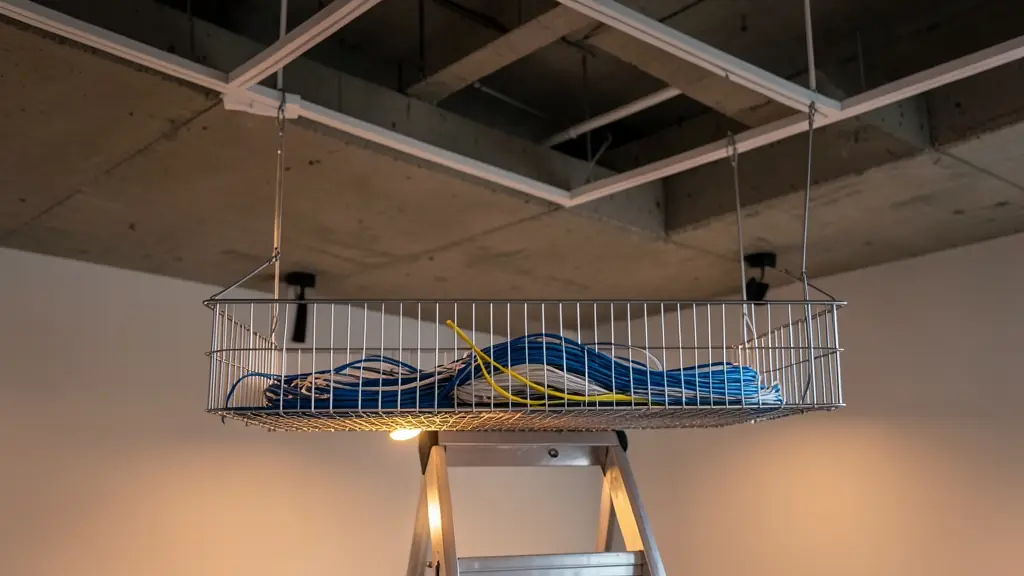
Wire mesh cable tray, also called wire basket tray or basket cable tray, is a grid of welded steel wire bent into a U. It weighs a fraction of sheet tray, you can see every cable through it and air moves freely around the bundles. It is the usual choice for data, fibre, CCTV and alarm cabling above ceiling tiles and under raised floors. An IT manager in Midrand moving 60 desks onto a new floor will almost certainly have a basket route above the corridor. Here is how it works.
Why installers like basket tray
- Cut and bent on site. Snip a few wires with bolt cutters and bend the basket into a corner, a tee or a drop. No factory bends to order.
- Light. One person can lift a length into a ceiling and hold it while a second fixes it.
- Open. Cables stay cool, a faulty patch lead can be traced by eye, and dust does not collect the way it does on solid trays.
- Easy to add to. A new camera cable simply drops into the basket and gets tied in place.
Sizes, finishes and fixings
Widths commonly range from about 50 mm for a handful of cables to 600 mm for a data centre spine, with side walls of roughly 30 to 100 mm. Most indoor basket is electro zinc plated; hot dip galvanised or stainless is used in damp, outdoor or coastal places. It hangs from the slab on short brackets or threaded rod, sits on raised floor pedestals or fixes along a wall. Supports go closer than for sheet tray with heavy loads; check the supplier's data sheet and the cable tray load calculator if the basket will be full.
Data centres, offices and server rooms
In a server room, basket runs above the racks carry copper and fibre to each cabinet, often in two layers. Under a raised floor it keeps cables off the slab and out of the cold air path. In an open plan office the basket follows the corridor in the ceiling void, with drops at each column to the floor boxes or the dado. Keep fibre on its own section or a separate basket, because a fibre cord crushed under copper bundles stops working.
Bonding and keeping power apart
Basket is metal, so the electrician bonds it to earth with clamps and checks continuity where lengths join. If low voltage power must share the route, use a divider or a separate basket at a set distance, so mains and data stay apart. For heavier power runs move to cable tray. Tidy patching at the desk end is covered in cable management.
What to put in your request
- Give the route length and basket width
- Say ceiling void or raised floor
- Give the height to the slab
- Count drops down to desks or racks
- Say if power must share the route
Wire Mesh Cable Tray: who asks for them and why
- Homeowners, landlords and DIY: a short basket in a roof space for the fibre router, cameras and access points
- Electricians and electrical contractors: a light route for alarm and intercom cables laid in before the ceiling boards go up
- Offices, co-working spaces and IT teams: the corridor basket above the tiles that feeds every desk cluster on an open plan floor
- Shops, restaurants, salons and malls: basket above a shop ceiling carrying CCTV, point of sale and music cables to the back office
- Factories, warehouses, mines and workshops: a separate basket for control and sensor cables beside the power tray in a plant
- Builders, developers and shopfitters: basket routes set out in the ceiling before the ducting contractor claims the space
- Server rooms, data, CCTV and solar installers: two tier basket over the racks in a server room, copper below and fibre above
- Schools, clinics, churches and municipalities: school and clinic networks run in ceiling baskets between classrooms and consulting rooms