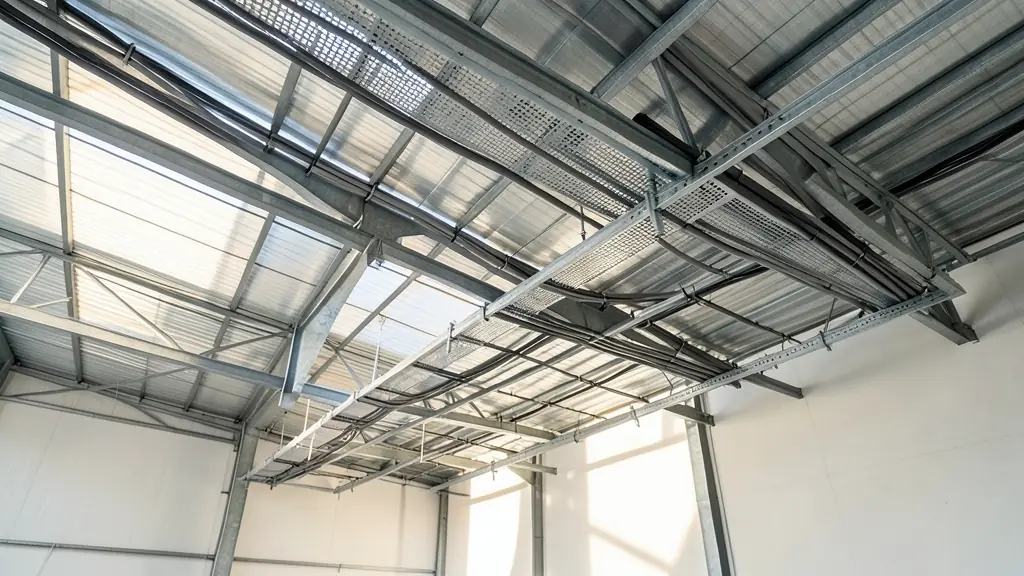
Cable tray is an open, flat bottomed channel with low side flanges and slots punched in the base. Cables lie in it rather than being enclosed, so they shed heat, stay easy to add to and can be tied down anywhere. It is how most warehouses, factories, shopping centres and office ceilings carry their sub mains and lighting circuits. A contractor in Germiston fitting out a 4,000 square metre store might run 250 m of it above the racking. Here are the materials, the cable tray sizes, the supports and what drives the cable tray price.
Galvanised, stainless or PVC
- Pre galvanised: made from coated sheet, then punched and formed. The cheapest and the common choice indoors in dry buildings. Cut edges have no zinc, so touch them up.
- Hot dip galvanised: dipped after forming, with a thicker coat on every edge. For outdoor runs, car parks, plant yards and the coast.
- Stainless: for food factories, dairies, chemical plants and seafront buildings where galvanising will not last.
- PVC or other plastic: light and rust free, used in corrosive areas with light loads, but it sags with heat and weight.
Widths, flanges and the fittings
Tray is named by width and the height of its return flange, the turned up side. Common widths run from 50 mm for a couple of cables to 600 mm and wider for a main plant room. Lengths are 2.4 m or 3 m, depending on the supplier. Each range has flat bends, inside and outside risers for changes in level, tees, crosses, reducers and couplers, all bolted together. Bends cost far more than straight tray, so a route with fewer turns saves money.
Supports, spacing and earthing
Tray hangs on threaded rod and channel, sits on wall brackets or rides on cantilever arms bolted to a column. As a rule of thumb supports go roughly every 1.5 to 2 m, closer for heavy loads and always near bends and joints; the supplier's load table sets the real figure. Add up the cable weight per metre in the cable tray load calculator before you settle the spacing. Metal tray is part of the earthing: the electrician bonds it and checks continuity across each coupler.
Tray, trunking or ladder
Choose steel trunking where cables must be closed in and out of reach, such as a corridor or a workshop wall. Choose tray where there are many cables overhead and they need air. Move to cable ladder once the cables get thick and the spans get long. For data and CCTV in a ceiling, wire mesh cable tray is often lighter and quicker.
What to put in your request
- Give the route length and the tray width
- Say indoor, outdoor or coastal
- Count bends, tees and risers
- Give the height to the roof or slab
- Ask for supports and fixings priced in
Cable Tray: who asks for them and why
- Homeowners, landlords and DIY: a short run of tray in a big garage or workshop to carry the inverter and borehole cables
- Electricians and electrical contractors: sub mains and lighting circuits laid in overhead tray instead of pulled through conduit
- Offices, co-working spaces and IT teams: the main tray above the ceiling tiles that feeds the floor boxes and the DB on each level
- Shops, restaurants, salons and malls: tray over the shop ceiling carrying signage, lighting and kitchen circuits from the mall DB
- Factories, warehouses, mines and workshops: galvanised tray across the factory roof to the machines, with drops down each column
- Builders, developers and shopfitters: tray routes drawn in early so ducts, sprinklers and lights do not fight for the ceiling
- Server rooms, data, CCTV and solar installers: separate tray for UPS and solar cables so the data basket above stays clear of power
- Schools, clinics, churches and municipalities: hospital and school plant rooms where many circuits leave the main board together