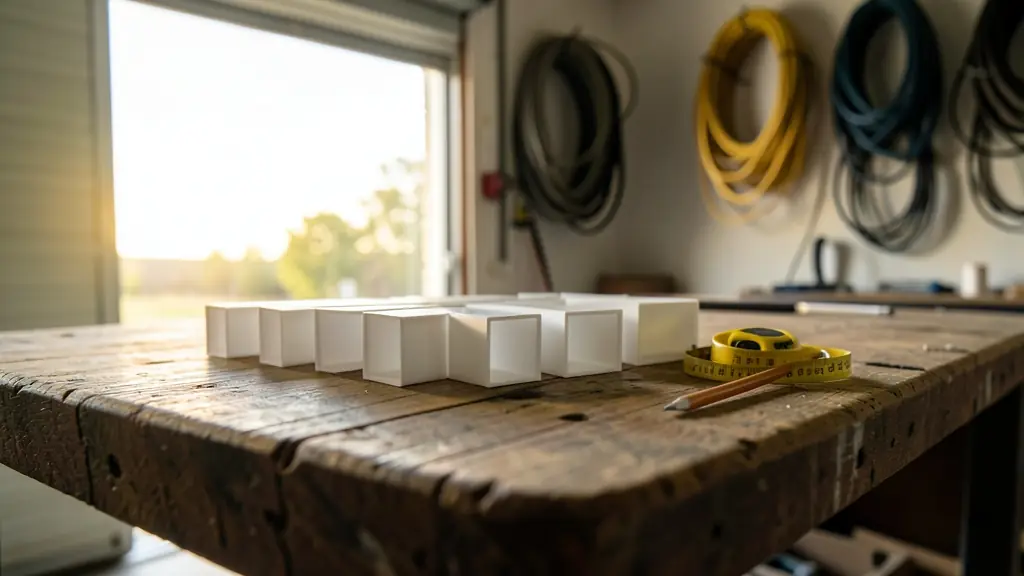
Trunking sizes are given as width x depth in millimetres, so 40 x 25 is 40 mm across the wall and 25 mm out from it. In South Africa PVC trunking runs from small 16 x 16 mm strips to 100 x 100 mm profiles that carry a sub main, all usually in 3 m lengths. The right size comes from the cables that go inside, not from what looks neat. Here are the common sizes, what each one roughly suits, and how to check the size against your own cable list.
Common sizes and what they roughly carry
| Profile in mm | What it often carries |
|---|---|
| 16 x 16 | One cable to a plug, a TV point or an alarm sensor |
| 25 x 16 | A few 2.5 mm² circuits along a skirting |
| 25 x 25 | A short branch with lights and plugs |
| 40 x 25 | Several circuits along a passage or classroom |
| 40 x 40 | A busy room run, or light power plus data with a divider |
| 50 x 50 | Many circuits leaving a DB board |
| 75 x 50 | Office perimeter runs with power and data |
| 100 x 50 | A sub main or a big bundle in a corridor |
| 100 x 100 | Risers, plant rooms and main routes |
Treat these as starting points. Your cable count decides.
Sizing from the cables
List every cable: its size in mm² and how many. Add up the outside cross section of each one from the cable data sheet, then compare it with the inside area of the trunking. The common rule of thumb is to fill no more than about 45 percent, and the electrician has the last word because heat and derating come into it. The trunking fill calculator does the sums and suggests the smallest size that works.
Compartments change the sum
A divided 100 x 50 mm profile is two channels of roughly 50 x 50 each, less the barrier. Size each compartment for its own cables: the power side and the data side are separate sums. Three compartment trunking needs the same treatment. Many people buy a divided profile thinking it holds as much as the undivided one and find the power side full before the job is done.
Why one size up is cheap insurance
The difference between 40 x 25 and 40 x 40 is small on a single length, but a run you cannot add to means a second run later, with new fittings and new holes in the wall. Go one size up where the route is a main path: the passage out of the DB board, a corridor in an office or a riser. On a short spur to one plug, the small size is fine. Then count your lengths with the quantity estimator, allowing for offcuts at each corner.
What to put in your request
- List the cables: size in mm² and how many
- Say which runs share power and data
- Give metres per size, not one total
- Say if you want room for future cables
- Ask the supplier to confirm inside dimensions
Trunking Sizes: who asks for them and why
- Homeowners, landlords and DIY: small profiles for a single plug or TV point and a bigger one out of the DB board
- Electricians and electrical contractors: sizing each run from the cable schedule before the order goes to the wholesaler
- Offices, co-working spaces and IT teams: a deep perimeter profile with separate power and data compartments sized for each
- Shops, restaurants, salons and malls: a mid size run along the counter feeding tills, scanners and under counter lights
- Factories, warehouses, mines and workshops: large profiles along the workshop wall carrying feeds to several machines
- Builders, developers and shopfitters: one size schedule for a whole block so the order and the fittings match
- Server rooms, data, CCTV and solar installers: data compartments sized with room for the extra network cables that always come
- Schools, clinics, churches and municipalities: classroom runs sized once for a whole school so every block uses the same stock