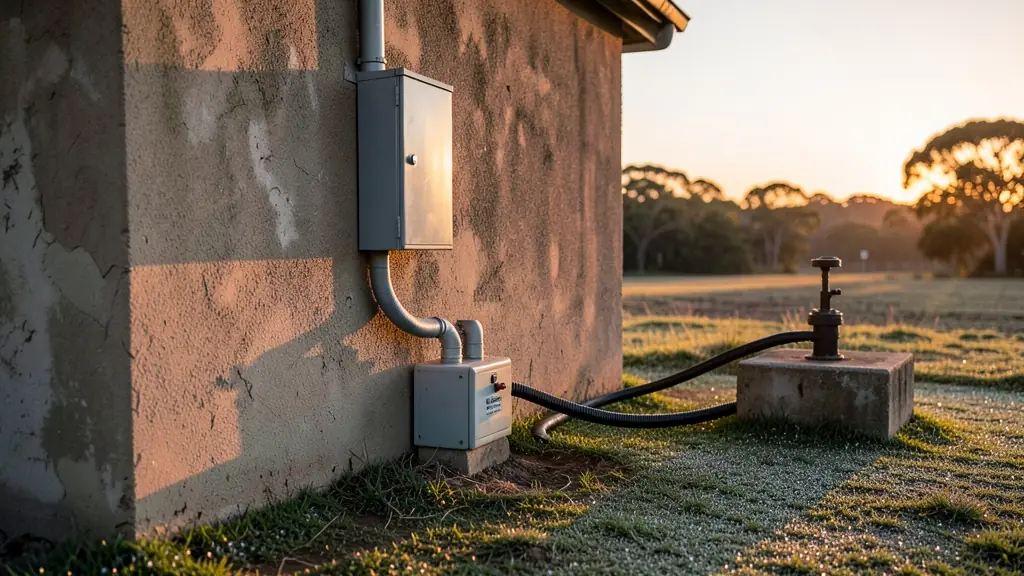
Flexible conduit is the ribbed or spiral tube that carries cable over the final stretch to something that moves, shakes or has to come out for service: a pool pump, a gate motor, a geyser element, an extractor fan or a conveyor motor in a Germiston workshop. Rigid pipe does the long run; the flex takes the last metre or so. Flexible electrical conduit comes in several kinds, and choosing the wrong one is how a pump cable ends up full of water after the first summer storm.
The four kinds you will be offered
- Corrugated PVC flex. Light, cheap and sold in coils. Fine inside drywall partitions, ceiling voids and behind a kitchen unit. It crushes if you stand on it and goes chalky in the sun unless the supplier says it is UV stable.
- Spiral PVC with a reinforcing wire or rib. Stiffer, holds its shape and survives being knocked by a mop or a toolbox.
- Steel flex (galvanised spiral). Mechanical protection where a forklift, a grinder spark or a rat might get at the cable.
- Liquid tight flex. Steel or plastic core with a PVC jacket, used with proper glands outdoors, at pumps and anywhere the floor gets hosed.
Glands and adaptors make or break it
The tube is only half the job. Each end needs a fitting made for that exact flex: a straight or angled gland into a motor terminal box, an adaptor from rigid conduit pipe to flex, or a coupler into a trunking run (see trunking accessories). Mixing a corrugated tube with a gland meant for spiral flex leaves a gap that lets in dust and rain. Ask the supplier for the matching gland size and its IP rating, and buy both from the same range.
Where flex belongs, and where it does not
Use it for the short drop to equipment that vibrates or gets moved: a compressor on rubber feet, a borehole controller, a sliding gate motor on its rail, a light fitting in a suspended ceiling that the tiler lifts. Do not use it for a 15 m run across a factory wall, under a driveway or along a floor where trolleys pass. It sags between saddles, collects dust in the ribs and is harder to pull cable through than smooth pipe. For buried runs see cable ducting.
Sizing and fixing
Flex is sized by its outside or inside diameter, commonly 16 to 32 mm for this kind of work, with bigger sizes for motor supplies. The ribs eat into the inside space, so choose one size up from what smooth pipe would need and check the fill with the conduit fill calculator. Leave a gentle loop so it can move without tugging on the gland, and clip the fixed part to the wall. If the equipment or the conduit is metal, the electrician earths it.
What to put in your request
- Say what it connects to and where
- Mention indoors, outdoors or hosed down
- Give the cable size and how many cores
- Ask for glands to match the flex
- Say how many drops and their lengths
Flexible Conduit: who asks for them and why
- Homeowners, landlords and DIY: the pool pump, the gate motor, the geyser and a light fitting lifted out of a drywall ceiling
- Electricians and electrical contractors: short drops from rigid pipe into motor terminal boxes, with glands in the van
- Offices, co-working spaces and IT teams: cables snaking round studs in drywall partitions during a fit out on a busy floor
- Shops, restaurants, salons and malls: extractor fans over a restaurant kitchen and fridges that get pulled out for cleaning
- Factories, warehouses, mines and workshops: conveyor motors, compressors on rubber feet and machines that shake all shift
- Builders, developers and shopfitters: drywall walls and bulkheads where rigid pipe cannot bend round the framing
- Server rooms, data, CCTV and solar installers: the cable drop from tray to a camera on a pole or a solar isolator on a frame
- Schools, clinics, churches and municipalities: pumps in a school borehole room and kitchen equipment in a clinic that gets hosed