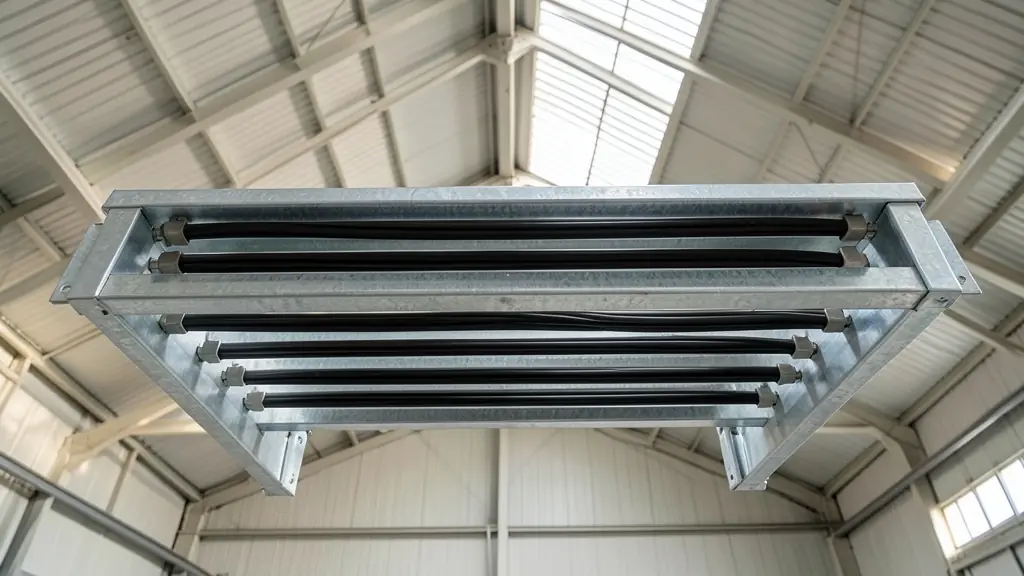
Cable ladder looks exactly like its name: two side rails joined by rungs, with nothing in between. Thick power cables lie across the rungs and are tied or cleated to them, air flows all round, and the rails carry the weight over long spans. It is what you see in substations, mine shafts, MCC rooms and the risers of tall buildings. A plant engineer in Rosslyn ordering 300 m of cable ladder rack for a new motor control room is working at a different scale from a ceiling tray. Here is how ladder is chosen and priced.
Rails, rungs and duty ratings
Ladder is sold as medium duty and heavy duty, by the depth and gauge of the side rails. Deeper rails span further between supports and carry more cable. Widths commonly run from about 150 mm to 900 mm, with rungs roughly every 250 to 300 mm, and lengths are usually 3 m or longer depending on the supplier. Most ladder is hot dip galvanised, which suits outdoor yards, mines and plants. Stainless and aluminium are used where corrosion or weight is the problem.
Spans, supports and the load
The big advantage of ladder is the span. Where tray wants a support roughly every 1.5 to 2 m, heavy ladder can often cross wider gaps between steel frames, but only within the supplier's load table for that rail and that cable weight. A run of large armoured cables can weigh more than you expect per metre. Work it out in the cable tray load calculator, then let the engineer and the supplier confirm the span. Do not walk on ladder; it is not a catwalk.
Cleats, risers and big bends
- Cleats: single core cables are held in trefoil or single cleats so a fault current does not throw them off the rungs. The electrician picks the cleats for the cable size.
- Risers: vertical ladder up a shaft or a wall, with cables cleated at intervals so their own weight does not drag them down.
- Bends: a thick cable needs a large bending radius, so ladder bends are wide and gentle. Order bends to suit the biggest cable on the run, not the average.
- Earthing: the ladder is bonded and each joint checked by the electrician.
Access, weight and installation
Ladder lengths are heavy and awkward, so the installer prices lifting equipment, scaffolding or a scissor lift as well as labour. Plan where cables will be pulled from, leave room above the ladder for hands and rollers, and keep the route clear of hot pipes. For lighter loads, cable tray or steel trunking may be enough; for single circuits to a machine, see steel conduit.
What to put in your request
- Give the metres and the ladder width
- Say medium or heavy duty
- List bends, tees and vertical risers
- Name the largest cable on the run
- Ask for access equipment priced in
Cable Ladder: who asks for them and why
- Homeowners, landlords and DIY: rarely needed at home, apart from a big farm shed carrying cables to an irrigation pump
- Electricians and electrical contractors: the route for sub mains from the transformer to the main board on a large site
- Offices, co-working spaces and IT teams: the riser ladder in a tower block feeding the DB on every floor
- Shops, restaurants, salons and malls: ladder in a mall plant room carrying feeders to each wing and the chillers
- Factories, warehouses, mines and workshops: heavy ladder over the MCC room and along the plant to the large motors
- Builders, developers and shopfitters: ladder and riser routes agreed with the engineer before the slabs and shafts close
- Server rooms, data, CCTV and solar installers: ladder for the UPS and generator feeders into a data centre, kept away from the data basket
- Schools, clinics, churches and municipalities: hospital, airport and municipal substations where heavy feeders leave the switchroom