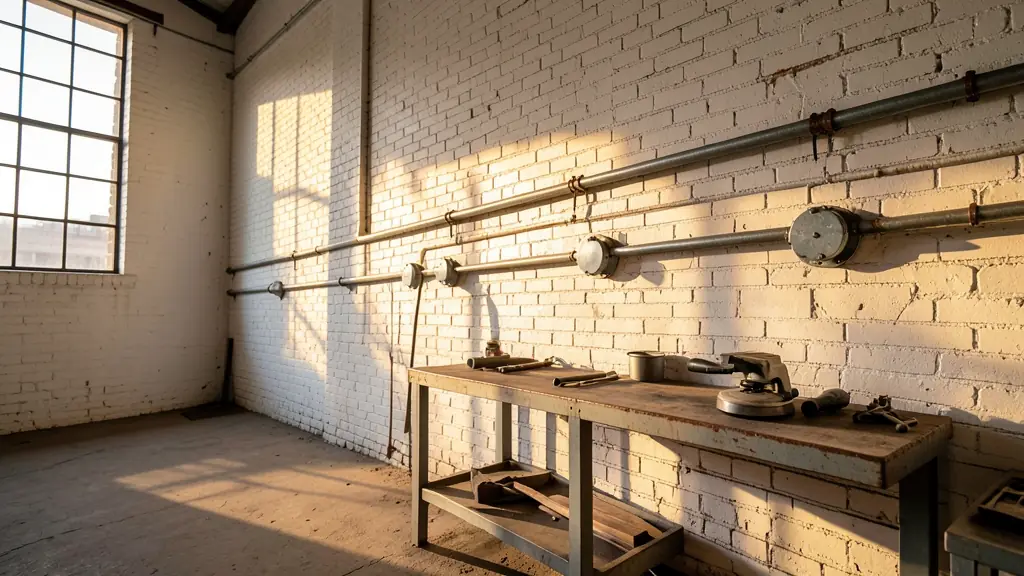
Steel conduit is galvanised tube, threaded at the ends and screwed into round boxes, couplers and elbows, that carries cables where plastic would be crushed, cut or burnt. You find it on the walls of a Vereeniging fabrication shop, in plant rooms, along the exposed soffit of a parking basement and in older buildings where the original installer put everything in metal. Galvanised conduit costs more to buy and to fit than PVC, so it pays to know when it is worth it and what it asks of the installer.
Where steel tube earns its price
- Exposed runs at hand height in workshops, where a forklift tine or a swinging steel bar would split PVC.
- Plant rooms, lift motor rooms and boiler houses with heat, oil and mechanical knocks.
- Fire escape routes and areas where the fire engineer or the building owner has asked for metal containment.
- Ceilings and walls where rats chew through plastic, a common story in grain stores and older warehouses.
- Heritage buildings where the client wants the industrial look on purpose.
For an ordinary house or office, chased PVC conduit pipe or surface steel trunking is usually the better buy.
The fittings and how a run goes together
A typical run is lengths of tube joined by threaded couplers, turned with elbows or a bend made on a hand bender, and broken by round boxes (terminal, through, angle and tee) where you need access or a light point. Spacer bar saddles hold it a little off the wall so dust and damp do not sit behind it. The installer cuts with a hacksaw or a pipe cutter, reams the inside so the edge does not skin the cable, and threads the end with a die. Bends need care: too tight and the tube kinks, and the cable will not pull. The conduit bending calculator works out offsets.
Earth continuity and rust
Metal conduit must be earthed, and every screwed joint has to be tight for the tube to stay continuous. Loose couplers or paint in the threads break that path, so the electrician tests it before issuing the CoC. Galvanising holds up well indoors. At the coast, in Durban harbour or near a mine dump, cut threads and scratches rust first: ask for a zinc rich paint on every cut and consider stainless or a heavier galvanised finish outdoors.
Weight, labour and comparing quotes
Steel tube is several times heavier than PVC and each thread, bend and box takes time, so labour per metre is higher. Quotes vary most on how many boxes and bends the route needs, so give the installer a sketch with every light, isolator and plug marked. Cable fill still matters: check it with the conduit fill calculator, and leave room for one more circuit.
What to put in your request
- Send a sketch with every box and bend
- Say the wall: brick, concrete or steel
- Mention coastal or corrosive air
- Give the cables the tube must carry
- Ask for threading and bending in the price
Steel Conduit: who asks for them and why
- Homeowners, landlords and DIY: a garage workshop wall or a borehole room where tools and a lawnmower knock the pipe
- Electricians and electrical contractors: threaded runs on workshop walls, with a die set, bender and reamer on the bakkie
- Offices, co-working spaces and IT teams: a basement parking soffit or plant room under an office block, exposed and within reach
- Shops, restaurants, salons and malls: a loading bay or cold room passage where trolleys and pallet jacks scrape the walls
- Factories, warehouses, mines and workshops: fabrication shops, boiler houses and grain stores with heat, oil, sparks and rats
- Builders, developers and shopfitters: exposed services in a warehouse conversion or a parking level, run before handover
- Server rooms, data, CCTV and solar installers: camera and access control cables on a perimeter wall where cutting them would matter
- Schools, clinics, churches and municipalities: pump rooms, hospital plant rooms and fire escape routes in municipal buildings