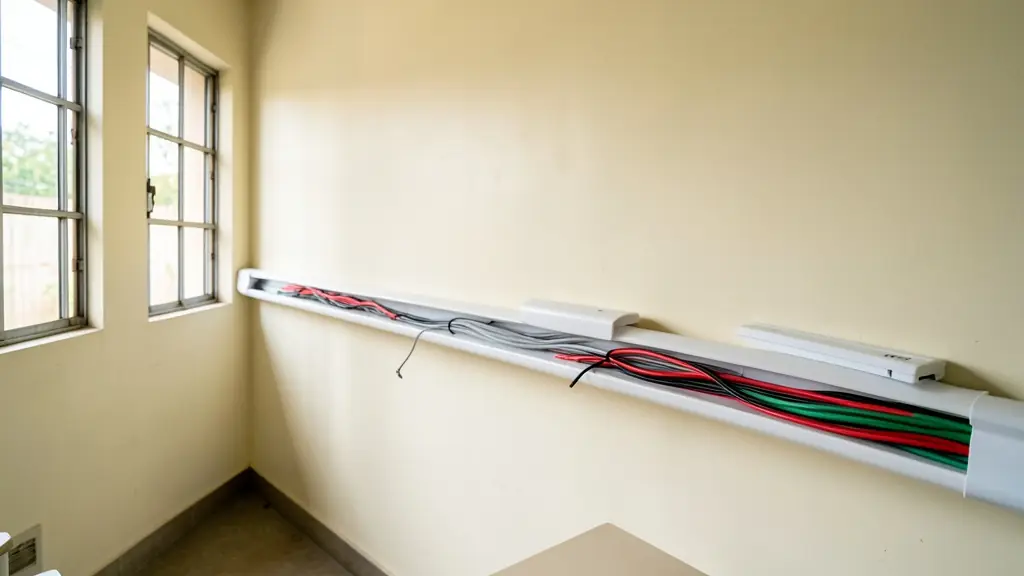
A lid that will not clip on is the clearest sign a trunking run is too small, but long before that the cables run warm and the next circuit has nowhere to go. This calculator picks the size from the cables themselves: choose each type, give a count, and it adds up the area they take and compares it with the inside of each common PVC trunking. Read what each size usually carries on trunking sizes, compare materials on PVC trunking, or count the lengths and corners with the trunking quantity estimator.
How the sum works
Each round cable takes pi x d² / 4 of the trunking, where d is its outside diameter from the maker's data sheet. A 2.5 mm² single core PVC wire is about 3.6 mm across, so it takes about 10.2 mm². Flat twin and earth is counted as its full width times its thickness, which errs on the full side. Add them all and divide by the inside area of the trunking: that is the fill. The common rule of thumb is to stay at or under 45%, and the electrician has the final say.
Three plug circuits in single cores, nine wires in all, take about 92 mm². That is 34% of a 25 x 16 mini trunking, which fits. Twelve Cat6 cables at 5.9 mm take about 328 mm² and need a 38 x 25 or larger.
Inside sizes, not the label
Trunking is named by its outside width x depth, but the cables only get the inside, less the wall, the lid's clip and any divider. The areas here are the inside areas a trunking maker publishes for its range. Sizes marked approx. were not in that table and are worked out as the outside size less a 1.5 mm wall each side. If you have the data sheet for the exact product, type its inside width and depth instead.
When to go one size up
- Power and data in one run need a divided trunking or two runs; size each compartment on its own.
- Many cables bunched together run warmer and may need derating; the electrician works that out.
- Plan for the circuit that comes later. The price gap between neighbouring sizes is small next to redoing the run.
- Socket boxes that clip into the trunking take up space inside it.
Frequently asked questions
Why 45% and not full?
My cable is not in the list. What now?
Can power and data share one trunking?
Who will quote me if I send a request?
More calculators
- Conduit fill calculatorCable sizes and counts in, the smallest conduit at 40% fill out
- Trunking quantity estimatorRoute or room, corners and ends in, lengths, fittings and fixings out
- Conduit bending calculatorOffset height and bend angle in, distance between bends and shrink out
- Cable tray load calculatorCables on the tray in, load per metre, width used and supports out
- Trunking cost estimatorMetres, material, fittings and labour in, a rough rand range out