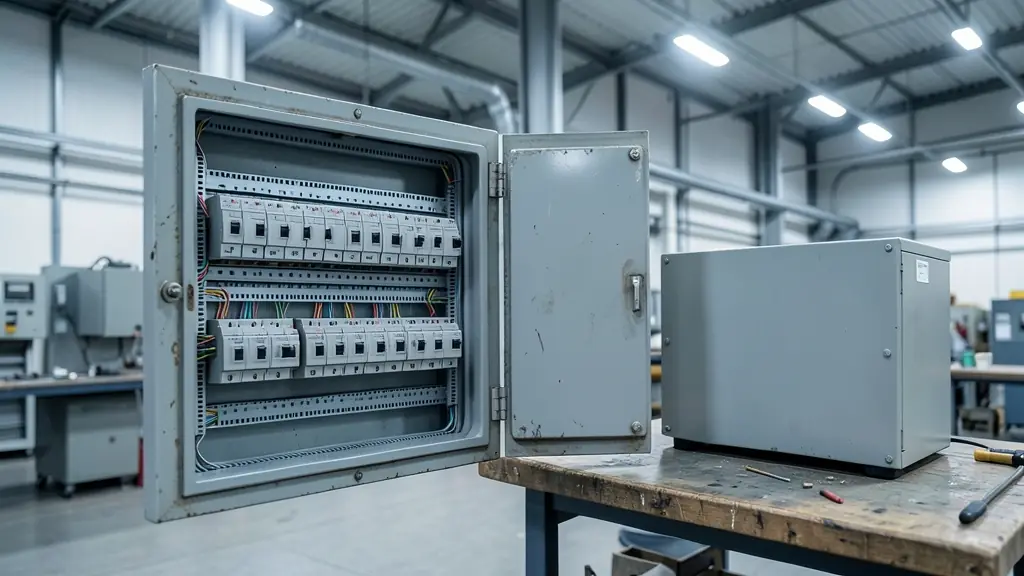
Slotted trunking, also sold as wiring duct or panel trunking, is the comb like channel that frames the rows of breakers, contactors and terminals inside a DB board, a control panel or an MCC. Each wire runs in the duct and leaves through the nearest slot, so a technician opening the door at a plant in Rosslyn at two in the morning can follow a circuit by eye. Panel builders buy it by the box; an electrician upgrading one board might need a single length.
Fingers, slots and break out
The walls of the duct are a row of fingers with gaps between them. Wires come in through the open top, run along the channel and leave sideways through a slot. Most fingers have a weak line at the base, so you can snap one off with side cutters where a thick cable or a bundle needs a wider exit. Narrow slot duct suits fine control wiring; wide slot duct takes heavier conductors. The lid clips over the top and holds the wires in when the panel is moved or vibrates.
Sizes and colours
- Widths and depths run from about 25 x 25 mm for a small board to 100 x 100 mm for the main runs in a big MCC.
- Grey is the standard in industrial panels, white is common in residential and commercial boards.
- It comes in 2 m lengths in many ranges, so check, and is usually fixed to the back plate with screws, rivets or push rivets.
- Halogen free versions exist for places where smoke matters, such as tunnels or hospitals; ask the supplier.
Laying out a panel around the DIN rails
A typical layout puts a horizontal duct above and below every DIN rail, with vertical ducts down each side tying them together. Leave enough gap between the rail and the duct for fingers and a screwdriver to reach the terminals. Size the duct for the wires you have now and the ones coming later: a panel stuffed to the lid on day one cannot take another motor starter. A rule of thumb many panel builders use is the same as for wall trunking, roughly 45 percent fill. Run the numbers through the trunking fill calculator; the full size range is on trunking sizes.
Heat in the panel
Contactors, drives and power supplies all make heat, and a duct packed solid keeps it in. Bundled cables in a hot enclosure may need derating, which the electrician or panel designer works out. Give the duct room, keep power and control wiring in separate ducts where you can, and leave the vent and fan paths clear. Panels on a mine or a plant room wall in summer run hot already. For the conductors leaving the panel to a motor or a valve, look at flexible conduit and steel trunking.
What to put in your request
- Give the duct sizes you need
- Say narrow slot or wide slot
- Say grey or white, and lids included
- Give the number of lengths or boxes
- Mention halogen free if specified
Slotted Trunking: who asks for them and why
- Homeowners, landlords and DIY: a new DB board in a house rewire, with the wiring laid neatly round the breakers
- Electricians and electrical contractors: replacing a messy board and leaving the next electrician a panel that can be traced
- Offices, co-working spaces and IT teams: the main board and lighting control panel in the building's electrical room
- Shops, restaurants, salons and malls: a mall shop's tenant board and the kitchen extraction control panel
- Factories, warehouses, mines and workshops: control panels and MCCs with rows of contactors, drives and terminals
- Builders, developers and shopfitters: boards for a block of units built in the panel shop before they go to site
- Server rooms, data, CCTV and solar installers: inverter, battery and solar combiner boxes with DC and AC wiring kept apart
- Schools, clinics, churches and municipalities: pump station, borehole and municipal lighting control panels