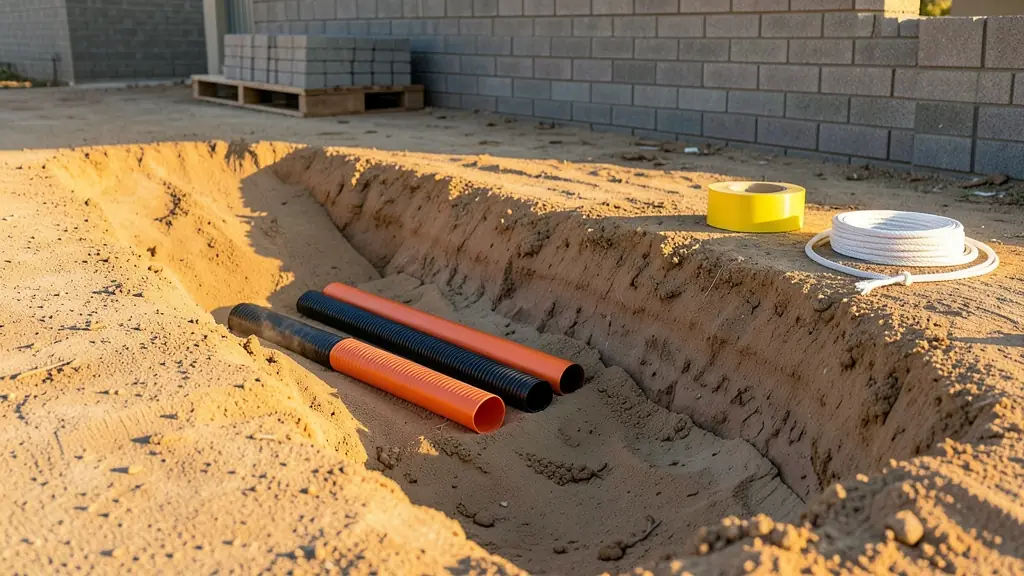
A cable duct is a pipe laid in the ground, or cast into a slab, so that cables can be pulled through it later instead of being buried bare. Think of it as a sleeve: under a driveway, across a lawn to the garden cottage, between two factory buildings or along a townhouse road to every unit. The cable can be replaced or added to without digging up the paving. Indoors some people also call surface cable trunking "cable duct"; this page covers the underground kind.
What cable ducting is made of
- HDPE pipe. Black or coloured polyethylene, tough and sold in long coils, so a run across a field can go in without joints.
- Corrugated twin wall duct. Ribbed outside, smooth inside, light and strong for its weight. The usual choice under driveways and roads.
- PVC sleeves. Rigid pipe for short crossings, such as under a garden path or through a foundation.
Colours often show what is inside (power, telecoms, fibre), but they vary by supplier and municipality, so the plan should say which is which. Inside the house, conduit pipe takes over.
Depth, bedding and warning tape
As a rule of thumb ducts under a driveway go at least about 500 to 600 mm deep, on a bed of sand with sand over them so stones do not crack them. A warning tape is laid in the trench a little above the duct, so the next person digging hits tape before cable. Under lawns and gardens the depth is still set by the electrician and the wiring code. Where the duct comes up at a wall, sweep it up with a long bend, not a sharp elbow, or the cable will jam.
Draw wire, pits and spare ducts
Every duct gets a draw wire or nylon rope left inside, tied off at both ends, so the cable can be pulled through later. Long runs and sharp turns need a pit or draw box: a small chamber with a lid where the installer can reach in and pull. Lay a separate duct for power and another for data, fibre or the alarm, and add one spare. On the Centurion development with 40 townhouses, the empty spare is the one that saves the paving when fibre arrives.
Plan it before the slab or the paving
Ducting is cheap while the ground is open and expensive afterwards. Before the paver or the concrete truck arrives, mark where the gate motor, the outside lights, the pool pump, the cottage and the borehole will be, and run a duct to each. Photograph the trench with a tape measure in it before backfilling. For the last short bit to a pump or gate motor, see flexible conduit, and size ducts with the conduit fill calculator.
What to put in your request
- Sketch the route with every end point
- Say what goes under: paving, road, lawn
- Mention power, data and fibre separately
- Ask if trenching and backfill are included
- Say when the paving or slab goes down
Cable Ducting: who asks for them and why
- Homeowners, landlords and DIY: a sleeve under the driveway to the gate motor and another across the lawn to the cottage
- Electricians and electrical contractors: sub main runs to outbuildings with pits, draw rope and a spare duct in the trench
- Offices, co-working spaces and IT teams: ducts between a main building and a guardhouse or a parking canopy with lights
- Shops, restaurants, salons and malls: power and data under a forecourt or to a pylon sign in a centre's parking area
- Factories, warehouses, mines and workshops: ducts between a factory, a substation kiosk and a warehouse, with draw boxes
- Builders, developers and shopfitters: ducts to every townhouse on an estate road, laid before the paving and kerbs
- Server rooms, data, CCTV and solar installers: fibre and CCTV ducts along a perimeter fence and solar cables from a ground mount
- Schools, clinics, churches and municipalities: ducts to floodlights at a school field, a clinic's generator and municipal street lights