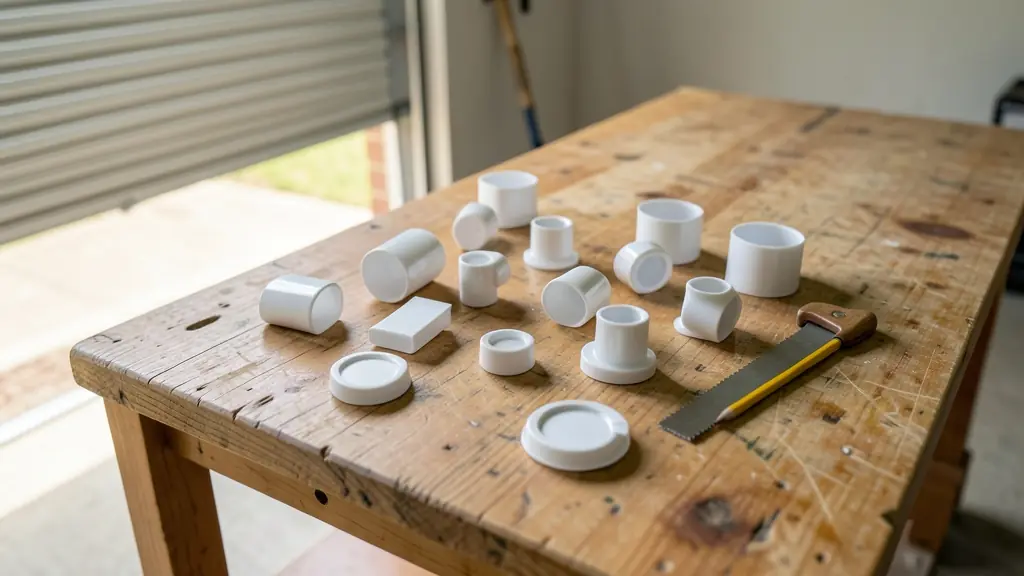
Trunking accessories are the small moulded pieces that turn straight lengths into a finished run: the trunking corner pieces (internal, external and flat angles), tees, couplers, the trunking end cap, boxes and adaptors. On a typical job they are a third of the line items and a surprising share of the bill. An electrician wiring a classroom in Benoni with 40 x 25 trunking might need 14 lengths and 30 fittings. Here is what each piece does, how to count them off a sketch and why they must come from one range.
What each fitting is for
- Internal angle: where the run turns into a corner of the room, wall to wall.
- External angle: round a corner that sticks out, such as a pillar or the edge of a chimney breast.
- Flat angle: a turn on the same wall face, along the wall and then up to a switch.
- Tee: a branch off the main run, down to a plug or up into the ceiling.
- End cap: closes the open end so no cable shows and no gecko moves in.
- Coupler or joint cover: hides the butt joint where two lengths meet.
- Reducer: steps from a bigger size down to a smaller one.
- Boxes and adaptors: surface boxes for sockets and switches, and a conduit adaptor where a 20 mm pipe leaves the trunking for a chased wall.
- Dividers: a clip in barrier that keeps power and data apart in one channel.
Why the fittings must match the trunking
Every maker shapes its lid lip a little differently. A tee from one range on trunking from another will either not clip on or pop off the first hot afternoon. Buy the fittings in the same size and from the same range as the lengths, and in the same white: two whites side by side look grey and cream once the run is up. If you already have trunking on the wall, take an offcut to the electrical wholesaler and match it there. See PVC trunking for the profiles themselves.
Counting fittings off a sketch
Draw the route on paper, one wall at a time. Mark a dot at every turn and every branch, then name each one: inside corner, outside corner, turn on the face, tee. Add an end cap wherever the run stops without going into a box, and one coupler for each joint between lengths. Add one or two spares of the fittings you use most, because a cracked corner on a Saturday means a wasted trip. The trunking quantity estimator does the same count from the room sizes.
Moulded fittings or mitred corners
Some electricians cut the trunking itself at 45 degrees and butt the ends, with no fitting at all. Done well it looks sharp, and it saves the cost of the angles. Done badly it leaves a gap at the lid and a sharp edge on the cable. Moulded fittings hide small cutting errors, cover the joint and give the cable a gentle turn. Our guide on how to cut trunking covers both.
What to put in your request
- Give the trunking size and colour
- List each fitting type with a count
- Say which range the existing run is
- Add spares of the common corners
- Ask if packs are cheaper than singles
Trunking Accessories: who asks for them and why
- Homeowners, landlords and DIY: a few angles and end caps to finish a new plug run in an old face brick lounge
- Electricians and electrical contractors: a bag of corners, tees and couplers counted off the drawing before the bakkie leaves
- Offices, co-working spaces and IT teams: tees and dividers where data and power branch off the perimeter run to the desks
- Shops, restaurants, salons and malls: end caps and boxes on the trunking behind a counter so the till cables look finished
- Factories, warehouses, mines and workshops: reducers and adaptors where heavy wall trunking steps down to conduit at a machine
- Builders, developers and shopfitters: a fittings schedule priced with the trunking so the fit out has no gaps on handover
- Server rooms, data, CCTV and solar installers: dividers and flat angles that keep fibre bends gentle and data clear of power
- Schools, clinics, churches and municipalities: tamper resistant end caps and screwed covers on school and clinic corridor runs