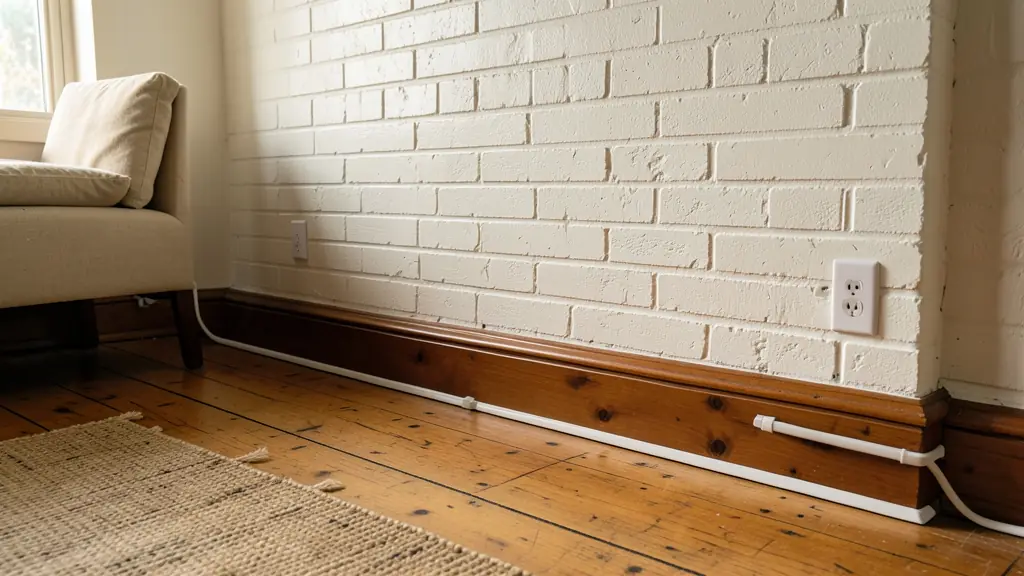
16x16 trunking is the smallest everyday size, and with 25 x 16 and 25 x 25 it makes up what people call mini trunking: a slim channel for a single cable or a small bundle. It is what you use when an old house in Observatory has face brick walls you cannot chase, when the TV sits on a wall with the decoder in a cupboard, or when an alarm installer needs to bring a sensor cable down from the ceiling. Small runs, but they are on show, so neat work counts more than size.
Which small size for which cable
| Profile (mm) | What it usually carries |
|---|---|
| 16 x 16 | One alarm, CCTV or speaker cable, or an LED strip feed |
| 25 x 16 | One 2.5 mm² circuit to a new plug, or a couple of thin data cables |
| 25 x 25 | Two light circuits, or a TV wall with HDMI, network and power leads |
A plug on an HDMI lead will not fit through any of them, so lay those in before the lid goes on. When in doubt, go one size up: the difference in price is small and the lid closes without a fight. For an exact answer, the fill calculator does the sum, and the bigger profiles are on trunking sizes.
Self adhesive or screwed
Most mini trunking arrives with a peel off tape along its base. That tape grips smooth, clean, dry paint for light cables indoors. It lets go on face brick, on dusty or freshly painted walls, in a hot garage and on anything that gets damp. The fix is simple: drill through the base, plug and screw it every 500 to 600 mm and close to each end and corner, and treat the adhesive as a help while you work. On a ceiling, always screw.
Corners, ends and painting it in
Small trunking looks cheap when the corners are rough. Use moulded internal, external and flat angles from the same range, or mitre the base and lid at 45 degrees in a mitre box; how to cut trunking shows the method. Cut the lid a few millimetres longer than you think, since a short lid leaves a gap at every joint. Run along the top of the skirting or tight into a corner, never across the middle of a wall. PVC takes paint once it is wiped down and given a plastic primer, so it can disappear into a coloured wall.
When small trunking carries mains power
A speaker or alarm cable in mini trunking is a DIY job. A new plug fed from an existing circuit is another matter: a registered electrician checks the circuit can carry the extra load, connects it and hands you a CoC. Ask the electrician to use trunking sold for electrical use, which is self extinguishing, not a decorative cable cover. Count your lengths and corners with the quantity estimator; for tidying a desk or a TV corner, see cable management.
What to put in your request
- Say which cables go in and how many
- Give the route length and the corners
- Name the wall: paint, face brick, tile
- Say white, black or paintable
- Say if a new plug needs an electrician
Mini Trunking: who asks for them and why
- Homeowners, landlords and DIY: a new plug in an old face brick house or the cables down from a wall mounted TV
- Electricians and electrical contractors: a single circuit added on the surface where chasing would wreck the plaster
- Offices, co-working spaces and IT teams: a phone or network cable round a doorframe to a reception desk
- Shops, restaurants, salons and malls: a feed to a shelf light, a sign or a card machine on a counter
- Factories, warehouses, mines and workshops: a sensor or a thermostat cable along a wall in a cold room or office
- Builders, developers and shopfitters: small surface runs on a snag list after the painters have finished
- Server rooms, data, CCTV and solar installers: alarm sensors, CCTV cameras and access readers fed down neatly from the ceiling
- Schools, clinics, churches and municipalities: a projector or speaker cable along a classroom or church hall wall