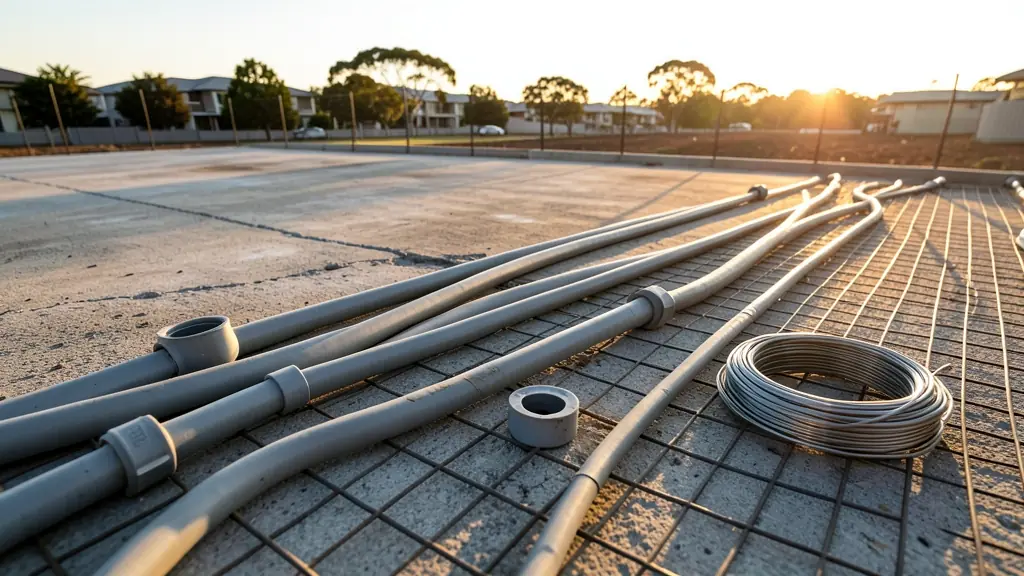
Conduit chased into a wall or cast in a slab cannot be made bigger later, so the size has to be right on the day the builder closes it up. This calculator takes the cables you plan to pull, adds up their cross sections and shows which conduit keeps them to the usual 40% of the bore, from 16 mm up to 50 mm. Read about the pipe itself on conduit pipe, the choice between the two systems on trunking vs conduit, or work out offsets with the conduit bending calculator.
Bore, not the size on the pipe
PVC conduit is named by its outside diameter. The bore is that less two walls, and medium duty walls run from about 1.8 to 3.1 mm depending on size. The tool uses the thickest published wall, so 20 mm conduit counts as a 15.8 mm bore, about 196 mm², and 25 mm as a 20.8 mm bore, about 340 mm². Heavy duty walls are thicker again: if you use it, type a lower fill or check the bore on the data sheet. The 16 mm bore is our estimate.
40% and the one or two cable case
The rule of thumb for conduit is 40% of the bore. Seven 2.5 mm² single cores fit a 20 mm conduit at 36%; the eighth takes it over. A 25 mm conduit takes thirteen. One published wiring code is stricter with two cables, 31%, because two cables lie side by side and jam on a pull, and allows 53% for a single cable. Switch the rule in the tool to see that version. Long runs and many bends call for less, and the electrician confirms the final size.
Before the slab is poured
- Leave a draw wire in every conduit so cables can be pulled in later.
- Use a size up for runs to the DB board, where circuits gather.
- Keep bends gentle and few; each one adds friction on the pull.
- Run data in its own conduit, apart from the power.
Frequently asked questions
Is 20 mm conduit enough for a plug circuit?
Can I pull flat twin and earth through conduit?
Why does the tool round sizes up?
Do you supply conduit or install it?
More calculators
- Trunking fill calculatorCable sizes and counts in, the smallest trunking that keeps to 45% out
- Trunking quantity estimatorRoute or room, corners and ends in, lengths, fittings and fixings out
- Conduit bending calculatorOffset height and bend angle in, distance between bends and shrink out
- Cable tray load calculatorCables on the tray in, load per metre, width used and supports out
- Trunking cost estimatorMetres, material, fittings and labour in, a rough rand range out