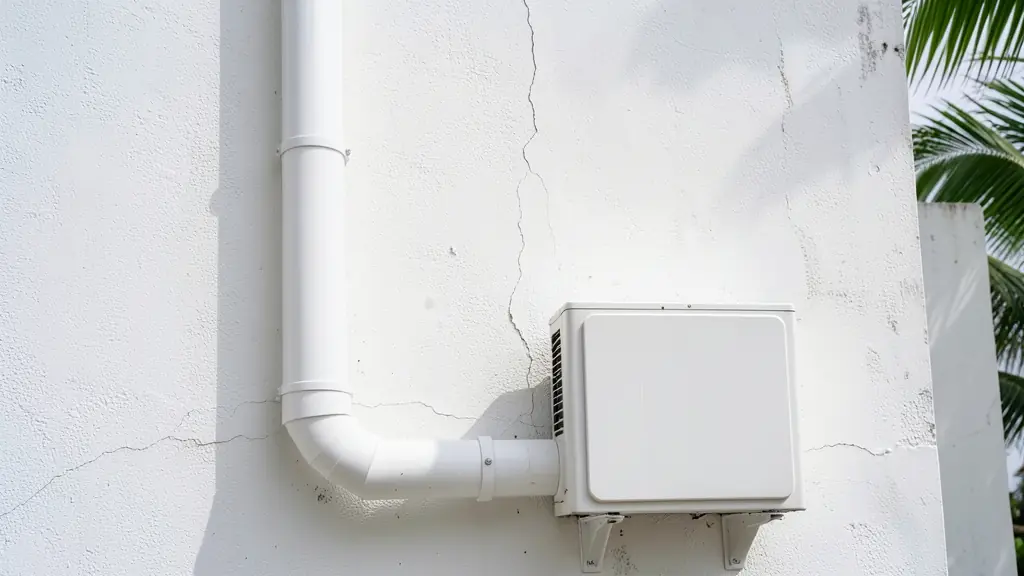
Aircon trunking is the pipe cover that hides the copper refrigerant lines, the condensate drain and the interconnecting cable of a split unit between the head unit inside and the outdoor unit on the wall. Bare pipes wrapped in tape look shabby within a year, and the insulation cracks in the sun. A cover keeps the lagging dry, protects the pipes and makes a block of flats in Durban or a row of offices in Centurion look like someone planned it. The aircon installer usually supplies and fits it with the unit.
What makes aircon trunking different
Ordinary indoor PVC trunking is the wrong product outside. Aircon covers are made from UV stabilised PVC that holds its colour and stays flexible in full sun, with a deep, wide profile to take two lagged copper pipes, a drain hose and a cable side by side. They usually come in 2 m lengths, so check, in white, beige, grey or brown. The lid often clips from the front so the installer can open it later to find a leak without unscrewing the base.
Bends, wall entries and the end at the unit
- Wall entry cover: the flanged piece that finishes the hole where the pipes come through from the head unit.
- Flat and corner bends: internal and external corners for turning round a window frame or a building edge, and flexible joints for awkward angles.
- Connection piece: the end that meets the outdoor unit's valve cover so the pipes are not exposed in the last half metre.
- Couplers and end caps from the same range, so the lids line up.
A sketch of the wall fed into the quantity estimator gives the count; the wider fittings range sits under trunking accessories.
Drain fall, sun and salt
The condensate drain needs a steady fall all the way, so the route of the cover follows the drain, not the other way round. A cover run uphill to look tidy can trap water that ends up dripping inside on the wall below the head unit. In Durban, Port Elizabeth and anywhere close to the sea, use stainless or coated screws, because plain steel screws rust and stain the plaster within months. On a north or west wall in Polokwane or Upington, the sun is hard on everything, so UV stable material is not optional.
Body corporates and what goes in writing
Sectional title schemes often have rules on where outdoor units may go and what colour the covers must be. Ask the managing agent before the installer drills. Then ask the installer to include the cover in the quote as its own line, with the metres, the bends, the wall entry and the fixings, so it is not left off to win the job. The isolator and supply to the outdoor unit count as fixed wiring, so an electrician connects them and certifies the circuit. Rough figures: cost estimator; also see trunking installation and PVC trunking.
What to put in your request
- Give the number of split units
- Give the pipe run from head to outdoor unit
- Count the bends round windows and corners
- Say the colour the body corporate allows
- Say if you are near the sea
Aircon Trunking: who asks for them and why
- Homeowners, landlords and DIY: a bedroom split unit with the pipes covered down the outside wall to the outdoor unit
- Electricians and electrical contractors: the isolator and power cable to the outdoor unit run neatly beside the pipe cover
- Offices, co-working spaces and IT teams: a row of split units along a building face with matching covers on every floor
- Shops, restaurants, salons and malls: a shop or restaurant unit with the pipes covered on a wall the public can see
- Factories, warehouses, mines and workshops: a control room or a site office unit protected from knocks by forklifts
- Builders, developers and shopfitters: covers planned for a new block of flats so every unit looks the same
- Server rooms, data, CCTV and solar installers: comms room cooling with pipes covered where they pass the cable route
- Schools, clinics, churches and municipalities: clinic, school office and library units covered to survive the sun and vandals