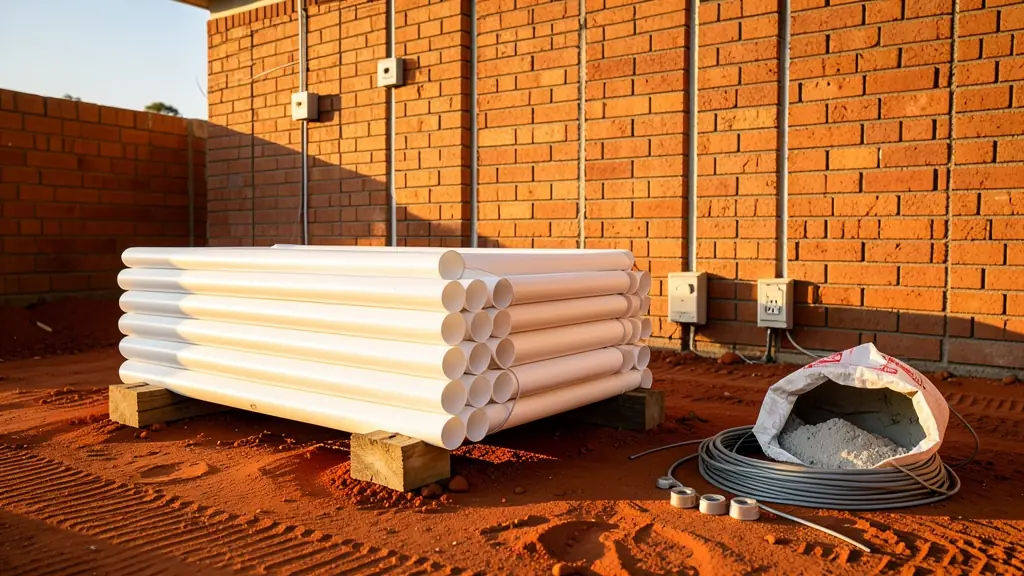
Conduit pipe is the round tube that wires run through inside walls, floors and ceilings. In South African houses it is nearly always PVC conduit, chased into the brickwork or cast into the slab before the plaster and the screed. The two house sizes are 20 mm and 25 mm; 32 mm and up go to sub mains and long runs. A builder in Centurion putting up 40 townhouses will order it by the bundle. Here is what PVC electrical conduit comes in, how it is fitted and how much cable it takes.
Sizes, duty and lengths
- 20 mm: switch and light drops, plugs on a single circuit. The size most people search for as conduit pipe 20mm.
- 25 mm: plug circuits with more cables, stove and geyser circuits, and the run from the DB.
- 32 mm and up: sub mains to a cottage, a garage or a second board.
Light duty conduit suits chases in brick that will be plastered. Heavy duty has a thicker wall for concrete slabs, where it gets walked on and has concrete poured over it. Lengths are usually 4 m, sold singly or in bundles, and fittings (couplers, bends, saddles, round boxes and adaptors) are sold per piece.
Chased in, cast in or on the surface
In a new house the electrician runs conduit in the slab before the pour, then up the walls in chases cut by a wall chaser once the brickwork is up, ending at the switch and plug boxes. The pipe is held in the chase with clout nails or plaster dabs until plastering. On a soffit or in a garage it can be fixed on the surface with saddles. In an old face brick home where chasing is not allowed, trunking may suit better than conduit.
Bends, springs and draw wires
PVC bends by hand with a bending spring pushed inside the pipe, so it curves without kinking; warm it slightly in winter. A smooth bend pulls cable far more easily than a tight factory elbow. Leave a draw wire in every run, especially long ones and any that are not wired yet, so cables can be pulled through later. Offsets round a beam are worked out in the conduit bending calculator.
How many cables fit, and sun on exposed pipe
The common rule of thumb is about 40 percent of the inside area filled, the rest left for pulling and heat. Three or four 2.5 mm² cables sit easily in 20 mm; more circuits need 25 mm. The conduit fill calculator does the sums, and the electrician has the final say. Standard PVC left in full sun goes brittle in a few summers, so use UV stable pipe or paint it. Under a driveway, use proper cable ducting instead.
What to put in your request
- Give the size and light or heavy duty
- Count the 4 m lengths needed
- List bends, couplers, saddles and boxes
- Say chased, cast in slab or surface
- Ask for draw wire and spring included
Conduit Pipe: who asks for them and why
- Homeowners, landlords and DIY: new plugs and lights in an extension, chased into the walls before the plasterer comes
- Electricians and electrical contractors: 20 and 25 mm runs from the DB to every point, with a draw wire left in each
- Offices, co-working spaces and IT teams: conduit drops inside partition walls from the ceiling tray down to switches and plugs
- Shops, restaurants, salons and malls: conduit cast into a new shop floor to an island counter before the tiles go down
- Factories, warehouses, mines and workshops: heavy duty pipe saddled along a workshop wall to lights and small machines
- Builders, developers and shopfitters: slab conduit laid with the steel before the pour on every unit of a townhouse block
- Server rooms, data, CCTV and solar installers: spare 25 mm pipes to a gate, camera pole or solar inverter, ready for later cables
- Schools, clinics, churches and municipalities: conduit in new classroom and clinic walls so the finished rooms show no cables