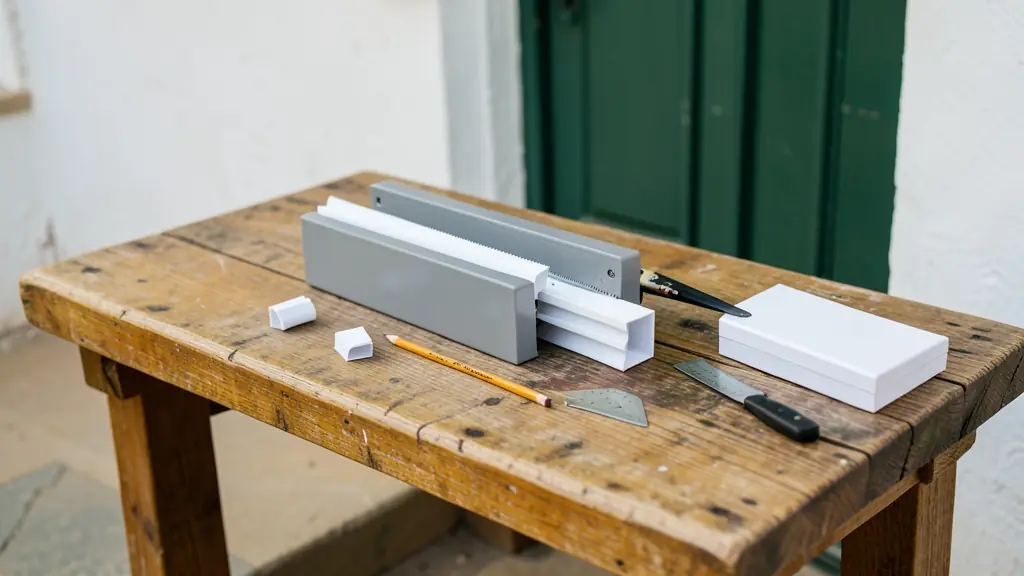
To cut trunking neatly, separate the lid from the base, mark the base against the wall where it will sit, hold it in a mitre box and saw it with a fine tooth blade, then cut the lid on its own once the base is screwed up. A 90 degree corner is two pieces each cut at 45 degrees that meet in an L. A straight joint is a square cut across the length. Below: PVC first, then the three corner types, then steel, which takes a grinder.
What you need on the bench
- A mitre box the profile fits into; a plastic one takes up to about 50 x 50, bigger sizes need a mitre saw.
- A junior hacksaw: the finer the teeth, the less the PVC chips.
- A pencil, a combination square, a tape and a craft knife for burrs.
- For steel: an angle grinder with a thin disc, a file, cold galvanising spray and safety glasses.
A dedicated trunking cutting tool is usually a ratchet shear for slotted panel duct; for a few lounge corners a mitre box does the same.
How to cut trunking at 90 degrees, step by step
- Fix the straight run up to the corner first, so you measure from something solid.
- Unclip the lid. Base and lid are cut as two separate jobs.
- Hold the next length in place and mark it: on the wall edge for an internal corner, on the outer edge for an external one.
- Stand the base in the mitre box as it sits on the wall and saw through the 45 degree slot on the waste side of the line.
- Cut the matching piece with the opposite 45 and offer both up dry. Shave a gap rather than recut.
- Deburr both pieces, then screw the base within about 100 to 150 mm of the corner.
- Measure each lid off the fixed base, mitre it the same way and clip it on last.
Internal, external and flat corners
An internal corner turns into a room corner, an external one wraps round a pillar or chimney breast, and a flat one stays on the wall, say where a plug height run turns up to a switch. For a flat corner the base lies on its back in the box and the 45 goes across the width.
Mitres look sharp on a painted wall but show every error. Moulded fittings from the same range clip over the lid and hide a rough cut, so most electricians use them on long runs. Moulded shapes are on the trunking accessories page; the quantity estimator counts them off your route.
Cutting steel trunking and tray
Clamp the length, cut base and lid apart with the grinder, file the edge smooth and spray bare metal with cold galvanising paint, more so near the coast. The electrician bonds across every cut joint to keep the earth continuous. More on steel trunking. Bends in conduit are another job: the conduit bending calculator works out offsets.
What to put in your request
- Give the run length and number of corners
- Say whether you want mitres or fittings
- Name the size, for example 40 x 25 mm
- Mention steel trunking or tray to cut
- Ask if offcuts and waste are removed
How to Cut Trunking: who asks for them and why
- Homeowners, landlords and DIY: a homeowner mitring a short run round a lounge corner for one new plug
- Electricians and electrical contractors: cutting dozens of corners a day on a school block where fittings run short
- Offices, co-working spaces and IT teams: neat mitres along a boardroom wall where moulded fittings would look bulky
- Shops, restaurants, salons and malls: a shopfitter cutting trunking round a till counter and a display plinth overnight
- Factories, warehouses, mines and workshops: grinding galvanised trunking and tray to length in a plant room, edges painted after
- Builders, developers and shopfitters: a fit out crew cutting lengths to suit the snag list before handover
- Server rooms, data, CCTV and solar installers: a security installer trimming mini trunking to follow a cornice to each camera
- Schools, clinics, churches and municipalities: clinic corridors where clean corners matter because the run is in full view