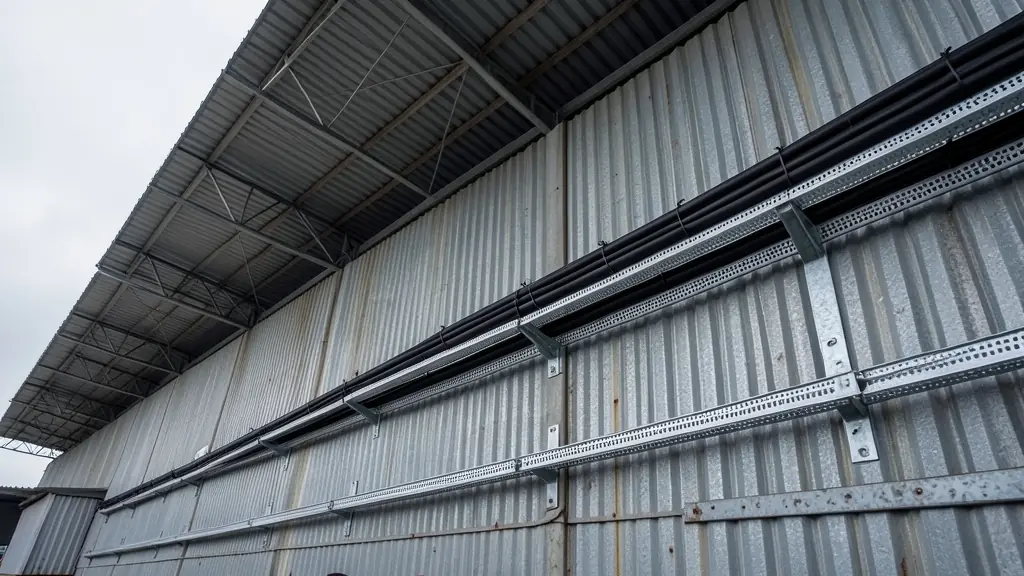
A tray that sags between brackets has usually been loaded past its span, not built badly. This calculator weighs the cables before they go up: pick each cable, give a count, and it adds up the kilograms per metre from cable makers' data, checks the width they need in one layer and counts the supports along the run. Compare containment on cable tray, go heavier on cable ladder, or price the run with the trunking cost estimator.
Load per metre and per span
Armoured cable is heavy. A 4 core 16 mm² SWA cable weighs about 1.77 kg a metre and 4 core 95 mm² about 6.1 kg, while a Cat6 cable is under 0.04 kg. Ten 16 mm² cables put about 17.7 kg on each metre of tray. At supports 1.5 m apart, each span carries about 26.5 kg, and a 30 m run needs 21 brackets. The tool shows the load per metre, the load between two supports and the count.
Checking against the tray
Tray makers publish safe working loads in kg per metre for each width at each support span, and the figure falls quickly as the span grows. We found no published table we could use for all trays, so the tool asks for the figure from your supplier's table and compares. Our starting span is 1.5 m, the close end of the usual 1.5 to 2 m; change it to match the table. Brackets, threaded rod and the fixings into the slab must carry the same load.
Width and the second layer
- Laid in one layer, the ten 16 mm² cables need about 260 mm, so a 300 mm tray.
- Power cables in one layer lose heat better; stacking them may need derating, which the electrician works out.
- Keep data on its own tray or behind a divider.
- Metal tray must be bonded to earth by the electrician.
Frequently asked questions
Does the tray's own weight count?
When should I use ladder instead of tray?
My cable is not in the list.
Who can supply and install the tray?
More calculators
- Trunking fill calculatorCable sizes and counts in, the smallest trunking that keeps to 45% out
- Conduit fill calculatorCable sizes and counts in, the smallest conduit at 40% fill out
- Trunking quantity estimatorRoute or room, corners and ends in, lengths, fittings and fixings out
- Conduit bending calculatorOffset height and bend angle in, distance between bends and shrink out
- Trunking cost estimatorMetres, material, fittings and labour in, a rough rand range out