Foundational Concepts of Two-Way Radio Communications
How Radio Signals Carry Voice and Data
The air around us is never truly quiet. Radio waves carry voice and data through modulation, where a transmitter alters the carrier’s frequency or phase to encode audio or digital bits. A receiver then demodulates those variations back into an understandable message. This mechanic is identical in every two-way radio.
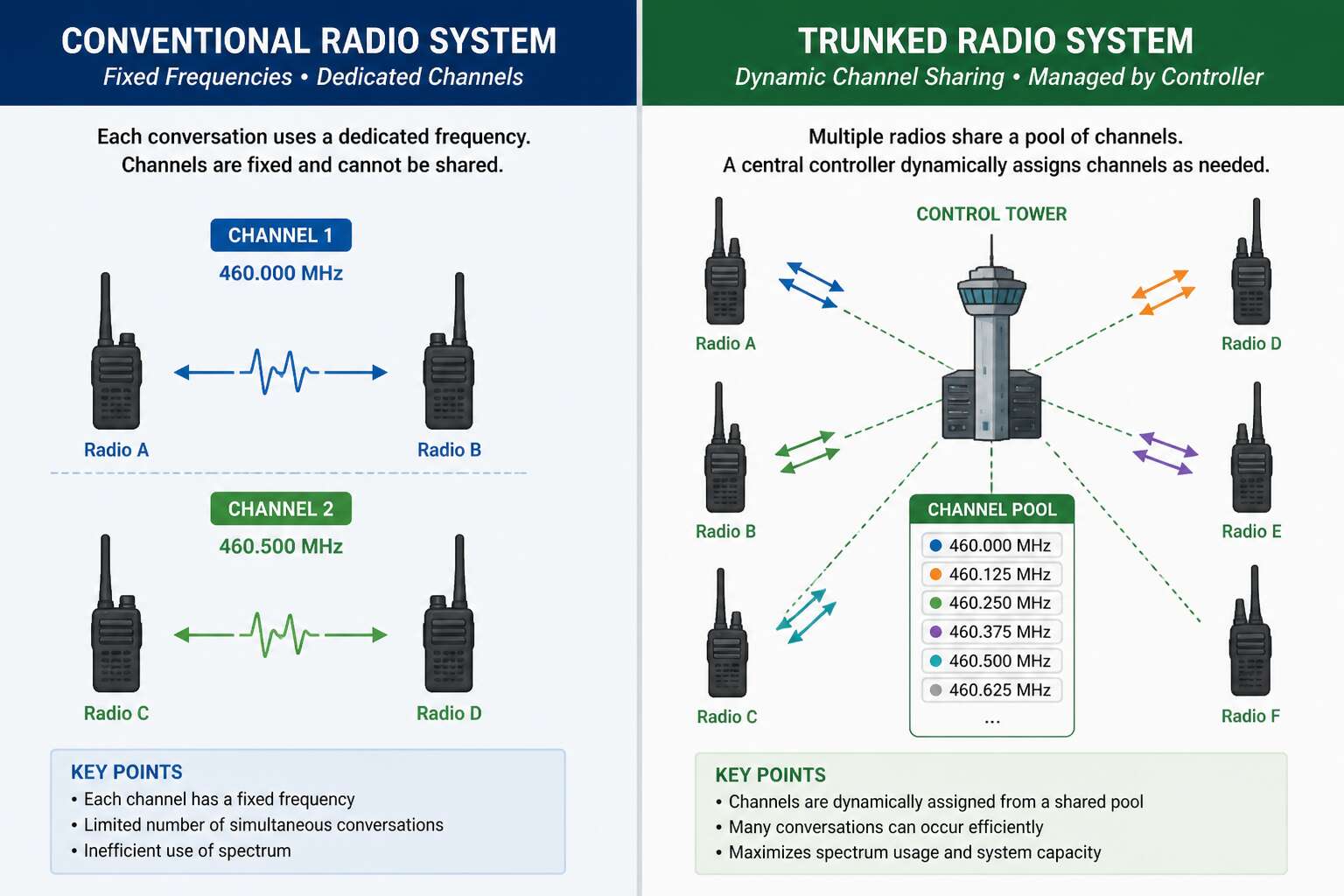
In a conventional system, each talk group owns a fixed frequency, so a channel is either occupied or open. Trunking sends every transmission to a central controller, which assigns a free frequency. The foundational layers remain:
- Modulation encodes information onto a carrier wave.
- Propagation carries the wave through distance and obstacles.
- Demodulation restores the original voice or data.
These layers never change. What changes is the decision logic behind each call, and that logic drives the operational differences in any trunking vs conventional radio system!
Understanding Channels, Frequencies, and Bandwidth
In South Africa, I have seen two way radio users confuse a channel with a frequency. A channel is a named pairing, like “Repeater 1”, while a frequency is the actual oscillation rate measured in hertz. Bandwidth is the amount of spectrum that transmission occupies, and getting it wrong causes garbled audio!
- Channel: a logical identifier assigned to a frequency pair.
- Frequency: the specific carrier wave location.
- Bandwidth: the spectral space needed for clear voice or data.
When comparing a trunking vs conventional radio system, the difference comes down to how these resources are managed. Conventional systems lock each channel to a fixed frequency. Trunking pools frequencies and assigns them on demand, so bandwidth usage becomes dynamic and efficient.
The Evolution of Land Mobile Radio Technologies
Back in the 1970s, a dispatcher in Durban had one radio channel and one prayer. If two fleets keyed up at once, the result was garbled nonsense and a lot of swearing. That was conventional radio: every user locked to a fixed frequency, and no one else could squeeze in.
The evolution of land mobile radio technologies flipped that model on its head. Trunking systems pool frequencies. When you press the talk button, a central controller assigns an available channel for that call, then reclaims it the moment you finish. That efficiency is the whole point of the trunking vs conventional radio system choice.
- Conventional: fixed channels, simple hardware, wasted capacity
- Trunked: pooled channels, smarter controller, higher throughput
What is Spectrum Efficiency and Why It Matters
Voice over a fixed frequency is a straightforward affair. But the radio spectrum is finite, and how we use it matters. Spectrum efficiency, then, is a measure of how many conversations can fit into a given portion of the spectrum. In a trunking vs conventional radio system, this measure is what separates the two.
A conventional system reserves a channel for you, even when you are silent. That silence still occupies space. A trunked system assigns a channel only when you press the button. Release it, and the controller reclaims the airtime.
- A conventional setup blocks others while one team transmits.
- A trunked setup allocates the spectrum to whoever needs it next.
The trunking vs conventional radio system decision, therefore, comes down to how many users you must serve with one frequency.
Exploring Conventional Radio Architecture
Dedicated Channels and Simple, Direct Communication
Conventional radio systems use dedicated channels assigned to specific user groups. Each channel remains fixed, so communication flows directly between radios without a central controller. This architecture works well for small teams that need instant, reliable contact.
- One frequency per group
- Simple push to talk operation
- No call setup delays
In my experience, South African farms and rural operations often rely on this setup because it tolerates poor infrastructure. However, when many users share limited frequencies, congestion becomes a problem. Understanding trunking vs conventional radio system tradeoffs helps you choose the right approach.
Who Uses Conventional Systems Today
Conventional radio architecture still powers many operations today. Beyond farms, construction crews, security patrols, and event staff rely on dedicated channels for immediate voice contact. These users value simplicity. A radio is switched on, the channel is selected, and communication happens. There is no waiting for a controller to assign a path.
Who uses conventional systems today? Typically, organisations that operate within a limited geographic area and have a fixed team structure. Consider these examples:
- A mining contractor coordinating a small blast crew.
- A wildlife reserve linking rangers across a single camp.
- A municipality connecting water maintenance teams.
These groups do not need dynamic resource allocation. Comparing trunking vs conventional radio system reveals that conventional systems shine in predictable, low traffic environments. The tradeoff becomes clear when traffic grows, but for many South African operations, the dedicated channel remains the most dependable tool.
The Strengths of a No-Nonsense Approach
Conventional radio architecture is elegantly simple. It is a chain of three components: a transceiver, an antenna, and a frequency. Press the push-to-talk and your voice moves directly to the base station or to every radio tuned to that channel. No controller assigns a path. No network negotiates a connection. That is the entire system!
That absence of complexity is a genuine strength. There are fewer parts to fail. A conventional repeater on a koppie can carry a mine’s blasting crew through a shift without a single dropped call. The trunking vs conventional radio system debate often ignores this raw dependability.
When you strip away the intelligence, you are left with something invaluable: a channel that opens when you need it, not when the system permits it.
Hidden Drawbacks in Crowded Environments
Every channel has a saturation point. In a quiet valley, a conventional system seems unbreakable. Pack a dozen crews onto one frequency and the architecture begins to decay. Voices overlap. Transmissions collide. When two operators key up simultaneously, both messages dissolve into static. No controller intervenes. No queue forms.
The trunking vs conventional radio system comparison grows stark in these conditions. Conventional networks offer no arbitration. They cannot prioritise a distress call over routine chatter. They cannot find an empty path for a delayed transmission.
A crowded channel imposes a grim arithmetic:
– Operators pause, straining to hear if the air is clear
– Critical messages wait behind routine movements
– Some transmissions vanish entirely, without warning
That raw dependability becomes a burden. The simplicity that served the blasting crew becomes a bottleneck. In the trunking vs conventional radio system debate, this is where conventional architecture fractures.
Cost and Maintenance Aspects of Traditional Setups
The cost appeal of a conventional setup often rests on the price tag alone. A single repeater, a set of radios, and the network is live. But the arithmetic changes when coverage must expand. Every new frequency demands its own repeater, its own antenna, its own power supply at every site. The trunking vs conventional radio system decision often ignores this compounding hardware expense.
Maintenance in South Africa adds its own friction. Site technicians must travel to remote locations, often on poor roads, to service equipment that has no remote diagnostics. A solar panel failure or lightning strike can silence a channel for days. The trunking vs conventional radio system trade-off becomes clearer here, but digital trunking introduces licensing fees and complex software upkeep.
- Repeater hardware must be replaced every few years
- Battery banks degrade quickly in heat
- Switching to digital requires new infrastructure
Inside Trunked Radio Technology
Automatic Channel Sharing and Dynamic Assignment
Every radio in a trunked network is locked onto a control channel before the user speaks. That channel carries no voice. It only carries requests and assignments. When someone presses the push to talk, the system picks an available traffic channel and switches the radio over in milliseconds.
This is automatic channel sharing in action. After each transmission, the traffic channel returns to a common pool. Five channels can support more users than a conventional setup with five channels, because no channel is wasted on silence.
Dynamic assignment also changes how congestion feels. Calls queue by priority and receive channels as they free up. For organisations weighing trunking vs conventional radio system, the true difference is control. Conventional radio leaves the user to hunt for a clear channel. Trunked radio removes that burden. I have seen dispatchers adapt to this shift within days, not weeks.
The Role of Control Channels in Managing Traffic
The control channel is the arbiter of the trunked network. It carries no voice, only digital instructions. Every radio monitors it constantly. When someone presses push to talk, the control channel processes the request and assigns an open traffic channel in milliseconds.
This central management is where trunking vs conventional radio system becomes clear. Conventional users hunt for clear frequencies. Trunked users just talk.
The control channel manages priorities during congestion:
- Emergency traffic jumps the queue
- Routine calls wait their turn
- System updates continue quietly
Why Trunking Excels in High-Volume Networks
Inside a trunked network, the radio behaves like a small computer, negotiating with the infrastructure on every transmission. This constant dialogue is the heart of the trunking vs conventional radio system difference. It is also why trunking excels when the network gets busy.
Traditional setups force users to search for clear frequencies. Trunked networks remove that burden entirely. The central controller tracks active calls, available resources, and user priority in real time. Airtime is assigned and released continuously, eliminating idle gaps.
- The radio requests a channel
- The controller finds an open slot
- The call connects within milliseconds
- The channel is reclaimed as soon as the user stops transmitting
In crowded environments, this matters. The trunking vs conventional radio system comparison shows that trunked infrastructure manages thousands of calls with limited spectrum, while conventional systems struggle under the same load.
Typical Industries and Public Safety Use Cases
Inside a trunked radio system, the infrastructure is built around repeater sites connected to a central switching controller. Every radio constantly monitors a dedicated control channel, sending brief data packets when the user presses the push-to-talk button. The controller checks the user’s credentials, finds an available traffic channel, and routes the audio in milliseconds.
Mining operations, logistics fleets, utilities, and public safety agencies depend on this architecture. A trunked system handles dynamic grouping, such as creating a temporary talkgroup for all responders at an incident scene. The trunking vs conventional radio system contrast is clear when agencies from different departments must interoperate without planning radio programming in advance.
- Municipal utilities coordinate water and electricity repairs across districts
- Harbour authorities manage vessel traffic and terminal operations
- Metro police departments share encrypted channels with tactical units
For public safety, the system’s ability to prioritise emergency calls is a deciding factor. Routine traffic can be queued or dropped while higher-priority users get instant access. The trunking vs conventional radio system comparison favours trunking in these scenarios because airtime is allocated based on need, not on fixed assignments.
Managing Handoffs and Roaming in Trunked Systems
Moving through a multi-site trunked network requires no manual intervention from the radio user. The subscriber radio constantly measures signal quality from surrounding repeater sites. When the current site’s signal weakens, the central controller initiates a handoff to the best available repeater. The transition completes in milliseconds, so the ongoing call remains intact.
Roaming in these systems also carries authentication requirements. The radio submits its identity and credentials at each new site. The controller validates user permissions and updates talkgroup affiliations accordingly. The trunking vs conventional radio system contrast shows clearly here: a conventional radio can only go out of range when leaving a repeater footprint, while a trunked radio seeks a new site automatically.
- Signal strength drops below a defined threshold
- A neighbouring site reports a stronger signal for that subscriber
- The user crosses into a site reserved for a different agency
Upfront Investment and Ongoing Fees Explained
Trunked radio technology carries a sticker price that surprises many first-time buyers. A full system requires redundant controllers, multiple repeater sites, and enterprise-grade dispatch consoles. South African municipalities and mining houses regularly budget seven figures for the initial rollout.
Ongoing fees shape the real financial picture. Trunking vs conventional radio system comparisons often ignore these recurring costs. You will pay for spectrum licences, backhaul circuits, software updates, and technical support. Most vendors structure this as a monthly subscription per active subscriber, which scales as your fleet grows.
The total cost of ownership breaks down simply:
- Site acquisition and civil works
- Controller hardware and software licensing
- Monthly spectrum and network management fees
- Per-radio service and support contracts
These charges buy the intelligence that automatically assigns channels. When weighing trunking vs conventional radio system, look beyond the quote. The operational expenditure reveals the true cost.
Side-by-Side Performance and Practical Differences
Capacity: Handling Many Users Without Overload
During a peak incident, a conventional radio system tends to slow down. Each channel carries one conversation at a time, and when all channels are occupied, users wait. Trunking channels are assigned on demand. The control channel allocates free frequencies instantly, so the system handles sudden traffic surges without delays. The trunking vs conventional radio system comparison becomes sharpest here. A conventional radio system with ten channels supports ten simultaneous calls. A trunking system with ten channels supports many more talkgroups because not every user transmits at the same time. Consider a busy operation:
- Conventional capacity is limited by channel count.
- Trunking capacity adapts to actual usage.
- Conventional overload causes wait times; trunking spreads the load.
This is the essence of trunking vs conventional radio system. One is rigid, the other is adaptable. When emergency teams converge, the adaptable system prevents the delays that slow response.
Call Setup Speed and Response Time
Side by side performance reveals how quickly each system responds. In a trunking vs conventional radio system, the core difference hinges on automated frequency assignment. A trunked radio uses a control channel to allocate a free slot the moment the user presses the button. A conventional radio relies on the operator to find an open channel, which can introduce several extra seconds.
Call setup speed directly shapes real world response time. With trunking, setup often happens in under half a second. Conventional systems face longer delays when channels are occupied, especially during peak incidents. A small delay can shift the outcome of a coordinated operation.
- Trunking delivers immediate connection without user intervention.
- Conventional requires manual tuning and constant monitoring.
- Trunking maintains steady speed even as traffic rises.
The practical difference also changes training needs. Users on a trunking vs conventional radio system adopt different habits. Trunking users simply press and talk, while conventional users must listen before transmitting to avoid collisions. This affects how quickly each team reaches a clear channel in an emergency.
Coverage Area and Signal Reliability Compared
Coverage area and signal reliability often separate a radio purchase from a radio regret. In a trunking vs conventional radio system, the numbers on paper matter less than the terrain you actually work in. A conventional setup with a high site repeater can cover a wide valley, while a trunked network needs overlapping sites to maintain a clean signal. I have seen teams assume trunking automatically means better range, but that is only true when the network is built dense enough.
Consider these practical differences:
- Conventional signal strength depends on the single repeater’s height and power.
- Trunked systems spread the load, but each site has a finite coverage footprint.
Reliability follows the same logic. Conventional fails when the repeater fails, with no fallback. That is a hard rule! Trunked systems can redirect traffic to adjacent sites, but only if those sites exist. So the trunking vs conventional radio system choice often comes down to geography. For rural operations, a simple conventional channel wins. For urban sprawl, trunking offers more consistent performance, provided the operator maintains the network.
Scalability as Your Team Grows
Put a trunking vs conventional radio system side by side, and the difference appears when your team grows. A conventional channel handles a fixed number of users. Add people, and the channel gets busier. Audio quality holds, but wait time grows. Trunking absorbs new users through its control channels.
Scalability is about adapting quickly. A small crew works well on one conventional channel. Add a second shift or a new vehicle, and coordination becomes manual.
- Five new users: conventional radio works if everyone follows discipline.
- Fifty new users: trunking routes traffic without constant supervision.
In my experience, South African enterprises encounter this limit. The trunking vs conventional radio system choice decides how well they cope. Calls collide during peak hours. Conventional systems treat every user as equal, which is fine until demand outpaces capacity. Trunking treats the network as a shared resource, so the system chooses who talks next. That distinction is the real measure of performance.
Security, Encryption, and Privacy Options
A radio call is a public announcement unless you secure it. This is where the trunking vs conventional radio system decision becomes a privacy matter. Conventional analog channels broadcast in the clear. Anyone with a scanner can listen to your operations. Trunking often uses digital protocols with encryption built into the hardware.
I have seen South African security teams discover this with their own ears. Their dispatch communications leaked to anyone with a cheap receiver.
- Conventional systems need external scramblers, which are rare and costly.
- Trunking offers AES-256 encryption as a standard setting.
- Key management is simpler on a trunking network.
Privacy options depend entirely on your infrastructure. Trunking lets you turn on encryption per call. Conventional systems leave you exposed unless you retrofit expensive modules. For a fleet handling cash or personnel, the trunking vs conventional radio system choice becomes a security decision.
Decision Framework for Your Organization
Counting Users and Estimating Peak Traffic
Choosing between trunking vs conventional radio system demands a decision framework built on user count and traffic patterns. Begin by auditing every handheld and mobile unit that will connect. Include backup devices and seasonal staff. The total figure drives capacity planning.
- Map each user to a specific shift and communication role
- Record how many calls each user makes during a typical hour
Estimating peak traffic requires observing real operations, not projections. In South African mines, peak often occurs during shift changes. At ports, it aligns with vessel arrivals. Trunking versus conventional performance diverges here. A trunked network absorbs congestion; a conventional system makes users wait. That difference determines whether your team stays productive or loses momentum.
Mapping Coverage Requirements and Terrain
Coverage demands change with the ground beneath your antennas. A conventional system gives you a fixed footprint. Once you surpass that footprint, communication dies. In our work, trunking vs conventional radio system decisions often stumble on this exact point.
South African terrain is unforgiving. The Highveld’s flat expanses behave differently from the Drakensberg’s folds. A trunked network can use multiple sites and transfer calls between them. A conventional setup may need expensive repeaters in every valley.
Coverage mapping depends on:
- Physical obstructions like ridges and dense vegetation
- Building penetration for indoor users
- The distance between your control room and field teams
- Future expansion into new operational areas
Trunking vs conventional radio system choices become clearer when you plot each site on a topographic map. A signal that crosses one kilometer of open ground may die after three hundred meters through a built-up mining complex. The ground dictates the answer, not the marketing brochures.
Budget Constraints and Total Cost of Ownership
A radio system’s true cost is the one that appears after installation, when the invoices have been filed away. The trunking vs conventional radio system decision hinges on figures that don’t show up in the initial quote. Power consumption, site rental, technician callouts, and spectrum renewal fees accumulate quietly. A conventional network may look cheaper on paper. Then the first storm takes out a repeater on the escarpment, and the overtime bill tells a different story.
We build our decision framework around total cost of ownership over five years. That means accounting for:
- Spare parts and emergency maintenance for remote sites
- Licence renewals and regulatory fees
- Battery replacement and solar panel upkeep at off-grid locations
- Staff training as the system evolves
Trunked networks carry higher recurring charges, but they spread failure risk across multiple sites. The trunking vs conventional radio system question becomes a matter of risk appetite. Conventional setups shift that risk onto your maintenance crew. The cheapest quote rarely survives its first encounter with South African terrain.
Interoperability with Existing Agencies or Partners
Interoperability often decides the trunking vs conventional radio system question before any price comparison does. When your crews need to talk to municipal fire services, private security, or the neighbouring farming co-op, the radio system stops being a private matter. A conventional VHF channel is straightforward; everyone tunes to one frequency and speaks the same language. But when partners carry different bands or signalling formats, that simplicity becomes a barrier.
Trunked networks offer gateway options that link agencies through control channel management. That capability carries conditions; compatible infrastructure, shared governance, and coordinated licensing are required. Each partner’s fleet, maintenance schedule, and user training must align with yours. I have watched organisations discover this only after a crisis.
Practical tests revolve around spectrum ownership, contract flexibility, and how a volunteer group with borrowed radios would fare. Those answers shape the trunking vs conventional radio system calculus more than any coverage map.
Future-Proofing for Data and IoT Integration
The choice between trunking vs conventional radio system often depends on what your organization will need in five years, not what it needs today. I have seen teams purchase equipment that cannot adapt to changing data demands. A conventional setup uses one fixed frequency for all communication, which remains predictable. A trunked network manages multiple channels dynamically, so it can handle voice and data traffic together.
Future proofing for data and IoT integration requires you to examine sensor readings, telemetry outputs, and asset tracking streams. Can your radio system carry those payloads without disrupting voice? Will the control channel cope with frequent short bursts? Here is a practical framework:
- Estimate your data volume for the next three years.
- Test both systems with small, frequent data packets.
- Measure encryption’s effect on message delivery speed.
The trunking vs conventional radio system decision carries long-term costs. Selecting the wrong one now means replacing hardware later, so evaluate your data needs before you commit.




0 Comments