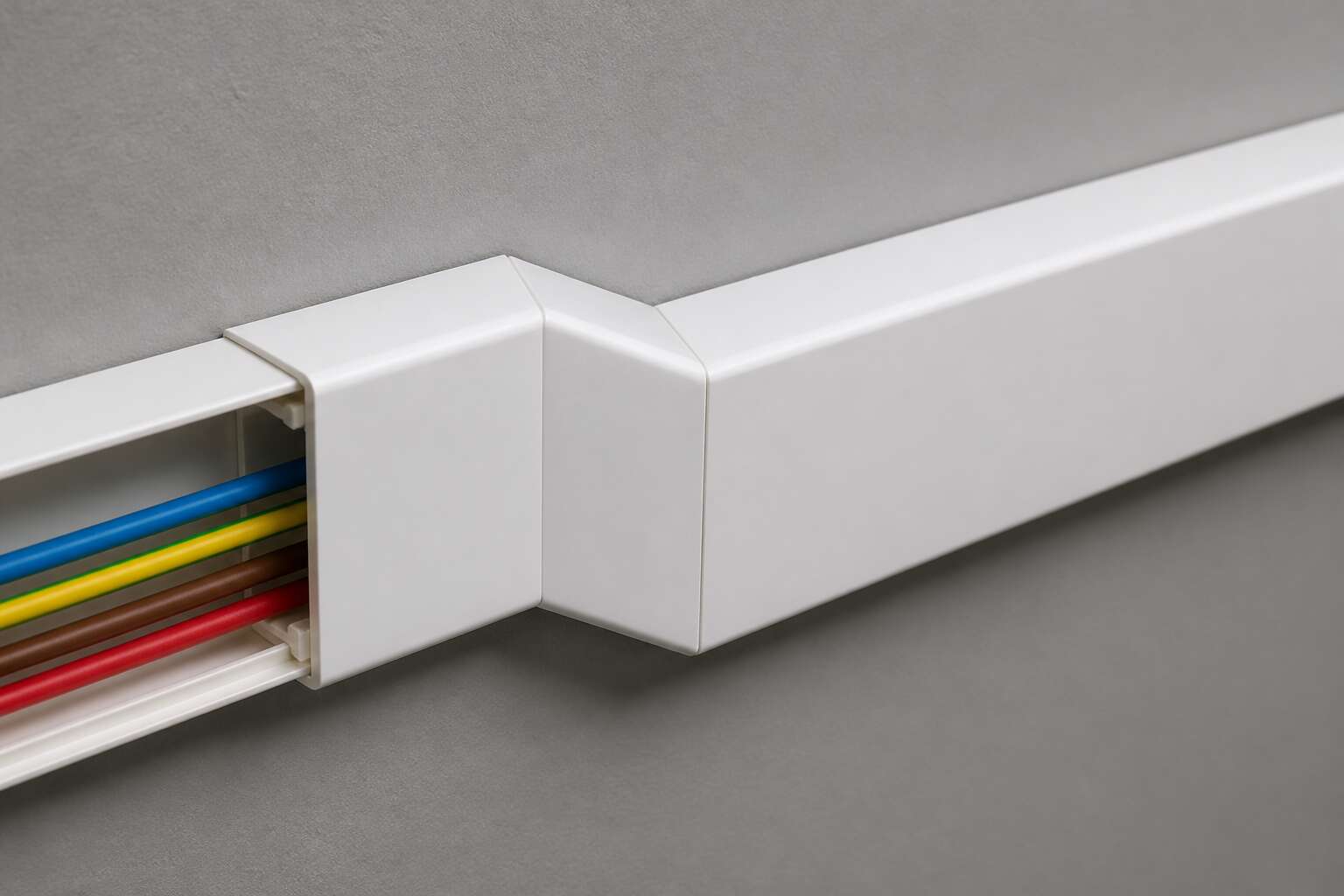
Understanding Trunking and Angle Fittings
What Is Cable Trunking?
Cable trunking is the protective enclosure used in structured electrical installations. It is a closed channel, typically made from PVC or metal, that houses and routes cables from one point to another. Without it, wiring becomes vulnerable to damage and creates a serious safety hazard. When you need to change direction, a trunking 45 darjah fitting becomes indispensable.
Angle fittings make directional changes possible. They allow installers to navigate corners and walls without bending cables to breaking point. A trunking 45 darjah fitting is ideal for gentle transitions, where a sharp 90 degree bend would be too aggressive. Common scenarios include:
– Routing cables along a roofline
– Navigating a wall corner with a shallow angle
– Adjusting direction around a beam
For South African electricians and DIY enthusiasts, selecting the correct fitting is not about aesthetics. It is about maintaining cable integrity and complying with SANS regulations.
The Role of Angle Fittings in Installation
Every year, poorly chosen angle fittings cause cable failures across South African installations. The trunking 45 darjah exists to prevent this. It creates a gentle change in direction, reducing strain on conductors that a sharp 90 degree turn would inflict.
Angle fittings preserve the bending radius, protect insulation, and keep the routing neat. When a wall corner or beam demands a shallow path, the trunking 45 darjah is the only sensible choice. I have seen too many installations where a tight bend shortened a cable’s lifespan dramatically!
- Along a roofline where a steep bend would kink the cable
- Around a beam set at an awkward angle
- Across a wall where a 90 degree turn would look harsh
Each scenario requires a fitting that matches the cable’s required path, not one that forces it.
Why 45-Degree Bends Matter
Most cable failures begin at a bend, not a straight run. The trunking 45 darjah turns that moment into a predictable transition. Understanding angle fittings starts with the wire inside. A 45 degree bend keeps the copper strands in natural alignment, while a sharper angle twists them and creates hot spots.
I have seen this pattern across industrial sites in Gauteng. The fix is simple: replace the sharp bend with a 45 degree fitting. This reduces friction during cable pulling, so less force lands on termination points.
The fitting also simplifies planning. You measure the wall depth, then choose the correct angle for the turning space.
Applications and Benefits of 45-Degree Trunking
Common Use Cases in Electrical Installations
A single sharp bend can halve a cable’s service life, yet most installations ignore this until it is too late. The trunking 45 darjah changes that calculation! In tight ceiling voids and cramped distribution boards, this fitting turns corners without forcing conductors into harsh angles. I have watched skilled electricians reach for it first when running multiple circuits through confined routes.
- Feeding power to surface mounted sockets along skirting lines
- Crossing from a wall cavity into an overhead tray without stress
- Guiding fibre and data cables around structural columns
Each use case shares one benefit: the gentle sweep preserves the cable’s internal structure. The oblique path of the trunking 45 darjah leaves more room for future additions, since pulling new wires through a 45 degree turn requires less effort than a square bend. For South African projects where heat and humidity expose poor workmanship, this fitting reduces callbacks and repairs.
Advantages Over 90-Degree Bends
A 90 degree corner is where cable damage begins. The sharp internal radius pinches conductors during pulling. The trunking 45 darjah changes that dynamic. It spreads strain over a longer arc, keeping the cable’s circular profile intact.
South African electricians feel the difference in their hands. A multi-core cable pulled through a square bend resists with every tug. Through a 45 degree fitting, the same cable runs smoothly. That lower pulling force preserves conductor strands and prevents sheath necking in hot roof spaces.
The benefits carry into maintenance work:
- Retrofitting new circuits takes less force
- Existing cables shift without damage when accessed
- Lubricant pools less at the corner
The trunking 45 darjah also conserves installation depth. A 90 degree fitting demands enclosure depth to achieve its bend. The 45 degree version uses less wall space, which helps when mounting containment in shallow voids.
Aesthetic and Safety Considerations
A 90 degree fitting declares itself loudly on a wall. The trunking 45 darjah does the opposite. It eases the transition between surfaces with a gentler sweep, so exposed trunking reads as part of the room, not an afterthought.
Safety follows the same principle. Where a sharp fitting leaves a ledge, the 45 degree version lets cables sit deeper in the channel. A technician opening the cover faces fewer snags. That matters in older installations where dust has already made access difficult.
The benefits extend to installation. During a retail fit-out in Cape Town, our team found that the trunking 45 darjah cut setup time noticeably. We did not need to shim the corners or force the channel into alignment.
These fittings perform best in tight layouts:
- Consistent reveal along the wall
- Simpler cutting and joining on site
- Secure seating for multi-core cables
Working with Space Constraints and Obstacles
Walls in older South African buildings seldom obey the plumb line. They tilt, bulge, and offer corners that refuse to meet at true angles. The trunking 45 darjah reads these distortions without amplifying them, bending around the flaws instead of exposing them.
Space restrictions demand the same tolerances. A ceiling bulkhead, an exposed stormwater downpipe, a security conduit, all crowding the same narrow passage. The fitting slips past each obstacle without forcing the installer to sacrifice radius or future cable access.
Cabinet and riser cupboards reward this approach too:
- Multiple bends stack within a shallow depth
- Returns align with existing skirting or dado lines
- Longer cable runs stay pullable around the sweep
Installation Techniques and Best Practices
Measuring and Cutting Trunking for 45-Degree Joints
Get the angle right before you pick up the saw. A combination square set to 45 degrees gives you a reference line, but the real trick is marking both sides of the trunking, not just the front face. Trunking 45 darjah joints fail when installers eyeball the cut and end up with a gap that no amount of force can close.
Once marked, secure the trunking in a vice or against a sturdy workbench. Use a fine-toothed hacksaw and cut slowly, following the line without forcing the blade.
- Measure twice, mark once on both faces.
- Cut on the waste side of the line.
- Deburr the edges with a file.
Clean edges matter more than you think. A rough edge catches on cables and makes the joint sit proud. When you fit trunking 45 darjah sections together, the two faces should meet with no visible light between them. That is your test for a proper cut!
Securing Fittings and Maintaining Cable Bend Radius
According to SANS 10142-1, the minimum bend radius for fixed cables is six times the cable’s outer diameter, yet most failures trace back to how trunking 45 darjah fittings get secured.
Installers attach the section with clips every 300 mm, keeping screws firm but not crushing. Over tightening distorts the channel and pinches the conductors inside. Heat cycles then cause the plastic to fatigue, and the joint opens up over time.
Maintaining cable bend radius inside the joint means guiding the conductors through the 45 degree turn without force. A draw tape works well. Sharp bends at the fitting exit create hot spots that degrade insulation and shorten circuit life.
Common Mistakes to Avoid
Alignment is the first discipline. A trunking 45 darjah joint only performs when both channel ends meet flush. Many installers assume the angle does the work, but the real skill lies in preparing the cut faces so the joint closes without gaps. Even a 2 mm offset becomes a weakness over time.
The most frequent mistakes are subtle. Misaligned holes force screws to pull the trunking out of true. Overheating the cut tip melts edges, creating burrs that snag cables. And mixing fixing materials, like steel screws into plastic channels without expansion allowance, invites cracking.
- Mark both sides of the joint before cutting.
- Use a fine toothed saw, not a grinder.
- Deburr every edge after cutting.
Take time to dry fit the assembly before fixing. That simple habit exposes problems while they are still easy to solve!
Tools and Safety Equipment Needed
Installation begins with the right tools. A sharp hacksaw, a spirit level, and a good quality measuring tape form the foundation. For the trunking 45 darjah joint, a mitre box keeps the angle honest. Power tools are optional; hand tools often give better control, especially in tight ceiling spaces.
Safety equipment matters just as much. Cut plastic trunking produces fine dust and sharp shards. Safety glasses protect your eyes, while gloves shield your hands from burrs. A dust mask is non negotiable when cutting multiple lengths.
- Mark the cut line with a pencil, not a marker
- Use a mitre box for consistent angles
- Check the blade is sharp before each cut
Secure the trunking loosely first, then adjust before tightening fully. This allows you to fine tune the alignment of the trunking 45 darjah joint without fighting the fixings. Take your time; it saves callbacks later.
Tools, Materials, and Product Selection
Essential Tools for Working with Trunking
Material selection makes or breaks a trunking 45 darjah joint. In South Africa, PVC dominates indoor runs, while galvanised steel is preferred where heat or impact threatens integrity. Always check the wall thickness of both trunking and its fittings. A thin profile might save money, but it deforms during cutting and compromises the required bend radius. Consider these options:
- PVC: lightweight, corrosion resistant.
- Steel: durable, heat tolerant.
- Aluminium: strong, lighter than steel.
Your tooling must match the chosen product. I have seen far too many installers use the wrong blade! A carbide tipped blade keeps PVC edges clean, whereas steel needs an abrasive disc. The right tool prevents burrs that weaken 45-degree faces. Selecting these components is not about immediate price. It is an investment in the reliability of every future connection.
Choosing the Right Trunking Material
Material choice determines whether a trunking 45 darjah joint survives the decade or fails within a season! In coastal South African towns, salt-laden air attacks galvanised steel, while PVC with UV stabilisers holds up better. Yet in industrial zones, heat and impact demand steel’s resilience. The product you select must match the environment, not the catalogue picture.
Wall thickness matters more than brand names. A thin wall deforms when you fit the angle, leaving gaps that compromise the bend radius. I always measure the cross-section and check for consistent density across the profile. A flimsy product might look neat on the shelf, but it will not hold screws or maintain alignment. For a trustworthy trunking 45 darjah installation, choose material that resists the specific weather, temperature, and mechanical load you expect. That decision saves rework later.
Compatibility of Fittings and Accessories
Compatibility starts with the product family. A trunking 45 darjah bend from one manufacturer rarely aligns with another brand’s cover clips or couplers. I always verify the fitting’s locking mechanism against the trunking profile before purchase. The accessory must seat flush, with no gap that would pinch the cable insulation.
- The internal diameter must match the trunking’s outer width.
- The screw type, captive or self-tapping, dictates the tool required.
- Moulded alignment ribs prevent sideways creep under load.
Materials affect accessory behaviour too. PVC expands with heat, so a rigid steel bracket may cause the joint to bow. For coastal conditions, choose stainless accessories for the trunking 45 darjah installation. The right pairing of tools and materials emerges only after you read the technical sheet, not the price tag.
Conduit vs. Trunking for Angled Runs
Choosing between conduit and trunking for a 45 degree change in direction often comes down to the future headache you are willing to tolerate. Conduit allows a tighter radius with a simple hand bender, but pull points become scarce. Trunking 45 darjah bends offer a removable lid, which makes cable inspection far less theatrical.
Material choice changes the tool list completely. For PVC trunking, I keep a fine tooth saw and a deburring tool. Steel trunking demands a hacksaw and a file, plus a chamfer tool to stop the sharp edge from eating the insulation. The product selection also depends on the run’s length. A short angled stub between two boxes suits conduit, whereas a long corridor with several branch points deserves trunking.
– Use conduit for a single cable and a tight space.
– Use trunking when you need future access without pulling the whole run.
The alignment ribs on a good trunking 45 darjah fitting also serve as a visual guide for the installer, which beats measuring twice.
Evaluating Quality and Durability
Price rarely reveals the true quality of a trunking 45 darjah fitting. I have seen expensive brands warp under moderate heat, while budget options with decent wall thickness survive years. The real test sits in the details.
Run a finger along the internal radius. A rough surface snags insulation. Inspect the cover alignment before installation. A fitting that sits flush today stays flush after the screws go in.
- Weigh two samples of the same size. Heavier usually means denser material.
- Flex the fitting gently. It should resist without cracking.
- Check the alignment ribs for even spacing.
The material should suit the site. Coastal installations need corrosion resistant steel or UV stabilised PVC. A trunking 45 darjah fitting that looks fine in the shop may fail within months in a Durban humidity cycle. Select for the environment, not the shelf appeal.
Maintenance and Compliance
Inspecting and Maintaining Trunking Systems
South African regulations under SANS 10142-1 rarely forgive sloppy maintenance. A trunking 45 darjah joint, when left unchecked, becomes a haven for dust, moisture, and loose connections. I have seen installations where the angle fitting pulled away from the wall, exposing live conductors. Regular inspection prevents that theatrical drama.
Focus on a few specific areas:
- Check the torque on fixing screws at the 45-degree bend.
- Look for cracking or warping in the PVC around the joint.
- Verify the earth continuity across the angle fitting.
Compliance means documenting each check. The trunking 45 darjah must remain accessible for future cable pulls. If the cover refuses to snap back, that is a warning sign. Address it immediately, before an auditor does.
Relevant Standards and Regulations
The SANS 10142-1 standard does not distinguish between a straight run and a trunking 45 darjah fitting when it comes to compliance. Both must meet the same requirements for mechanical protection and electrical continuity. In practice, that means your maintenance records need to show periodic verification, not a one-time installation check.
Relevant regulations extend beyond the wiring standard. The Occupational Health and Safety Act places a duty on the employer to ensure electrical installations are safe. For a trunking system, this includes the angle joint. If an inspector asks for proof, you need documented evidence of inspections and tests.
Records must remain accessible. A trunking 45 darjah that is not maintained according to the standard becomes a legal liability. The regulation is clear: accessibility for inspection is non-negotiable.
Cost and Efficiency Considerations
Routine maintenance of a trunking 45 darjah often costs less than an emergency repair, yet many facilities defer it until a fault appears. The angle fitting takes more mechanical stress than a straight section. A loose cover or compromised joint can lead to cable damage, downtime, and higher labour bills.
Efficiency improves when inspections and cleaning are scheduled. Dust and moisture accelerate corrosion, especially at the joint. A simple checklist keeps the process repeatable.
- Check torque on fixing screws every six months
- Verify the cover clips hold firmly along the bend
- Look for signs of heat discolouration on the fitting
Skipping these steps creates hidden costs. Replacing a damaged trunking 45 darjah means dismantling the run, sourcing matching components, and paying for overtime labour. Planned maintenance spreads the expense across the year and reduces the risk of unplanned shutdowns.
Future-Proofing Your Installation
Compliance with SANS 10142-1 is a legal requirement for low voltage installations in South Africa. The trunking 45 darjah must be installed to match the wiring regulations precisely. An inspector will check the bend radius and the mechanical protection it provides. Documentation of the installation forms part of the compliance file.
Future-proofing the run means thinking about capacity. A 45 degree fitting that serves today’s cables may need to accommodate additional circuits later. Selecting a larger trunking 45 darjah at the outset reduces the need for modification. The angle fitting should remain accessible for inspection and future cable pulling.
Planning points to record:
- The manufacturer’s specifications for the fitting
- The date of installation and the installer’s name
- The maximum cable fill percentage at the bend
These records support both maintenance schedules and compliance audits. They also guide upgrade decisions. A structured approach now protects the installation from becoming obsolete, and that is a worthwhile investment.

0 Comments