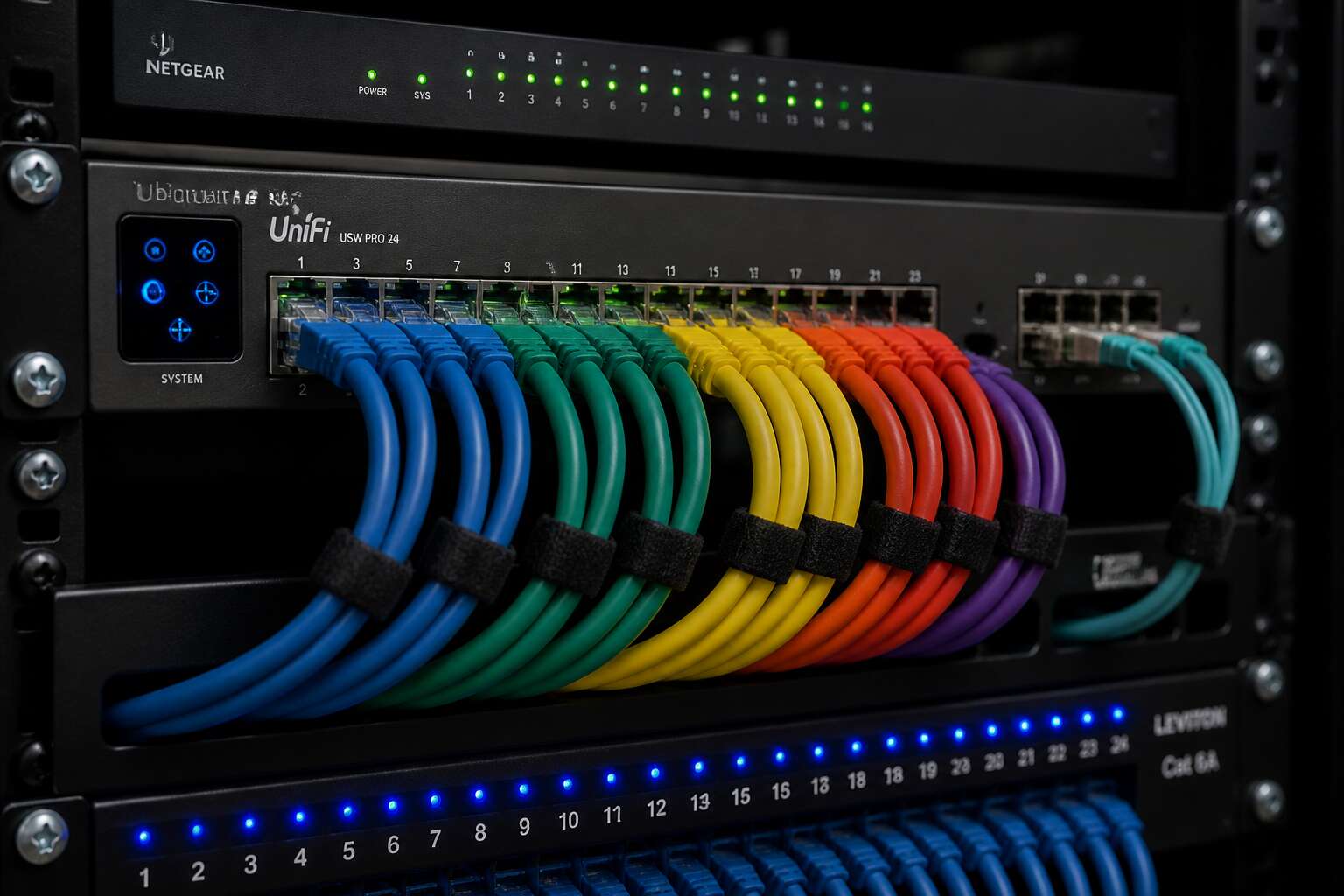
Network Efficiency and Bandwidth Optimization
Aggregating Multiple Links for Higher Throughput
Network efficiency often hinges on how well you utilise available bandwidth. Trunking allows you to aggregate multiple physical links into a single logical connection. This increases throughput without requiring expensive hardware upgrades.
Consider a scenario where your office in Johannesburg relies on four 1 Gbps lines. Without trunking, each line operates independently, limiting any single session to 1 Gbps. With trunking, you can combine them to achieve a 4 Gbps pipe. One reason why trunking is used is to eliminate that artificial ceiling.
- Load balancing spreads traffic across links.
- Failover ensures redundancy if one link drops.
- Cost effective scaling compared to new hardware.
Understanding why trunking is used becomes clear when you examine real world demand. Streaming, backups, and cloud apps quickly saturate a single link. Trunking removes that bottleneck, delivering smoother performance for every user.
Reducing Network Congestion with Trunked Paths
A single dropped video call during a client presentation is enough to make you question your entire network setup. Congestion is rarely about total capacity. It is about sudden bursts of traffic competing for the same path. Trunking solves this by giving data multiple routes to reach its destination.
This is why trunking is used in networks where timing matters. When multiple links work as one logical path, packets avoid the queue that forms on a single cable. That reduces latency spikes and packet loss during peak hours. For a Johannesburg office running cloud backups and VoIP, the difference is visible.
- Email attachments and shared drives during 09:00 login rush
- Video conferencing and remote desktop sessions
- Automated syncs from branch offices
Each of these activities competes for the same network resources. Trunked paths distribute that load across physical links, which keeps the network responsive without demanding constant hardware changes!
Simplifying VLAN Routing Across Switches
Why trunking is used becomes clear when I watch a network administrator trace a VLAN from one switch to another. Without trunking, each VLAN would demand its own cable and port, which quickly doubles the physical links in a rack. A trunk port carries multiple VLANs on a single connection, so routing logic stays manageable and bandwidth is shared between them.
Consider a school campus in Durban with separate VLANs for staff, learners, and guests. Trunking lets those VLANs share one uplink, and the switch tags each frame to identify its group. This is why trunking is used. It reduces the number of cables and frees ports for other devices. It also simplifies the spanning tree design because the trunk behaves as one logical path!
- Fewer cables lower the cost of installation and maintenance.
- Bandwidth pooling across VLANs improves switch utilisation.
- Routing tables remain small, so forwarding decisions happen faster.
Improving Performance with Link Aggregation Protocols
A single oversubscribed link in a Johannesburg office can ruin an afternoon. Link aggregation protocols, like LACP, solve this by spreading packets across multiple ports using a hash of their header data. The switch does not favour any one path, and no port becomes a bottleneck. That is why trunking is used in serious network designs: it enables efficient bandwidth pooling without constant reconfiguration. The protocol itself detects a failed member and routes around it in milliseconds, keeping applications alive!
- lower CPU overhead because load balancing happens in hardware
- incremental scaling, one port at a time
Efficiency becomes automatic, a property of the protocol rather than the planner.
Load Balancing Traffic Across Trunked Connections
Traffic in a live network never arrives evenly. It comes in bursts, often from a handful of chatty applications. This is why trunking is used. By distributing packet flows across trunked connections, the network avoids the lopsided behaviour where one port saturates while its neighbours remain idle. The load balancing logic inspects header fields and pins each conversation to a specific member link, so order is preserved and throughput stays predictable.
The practical gains show up during normal operations:
– fewer retransmissions during peak usage
– reduced latency spikes for interactive sessions
– steady utilisation across all physical ports
That steadiness is the real value of trunking. Network efficiency stops being a manual exercise and becomes a structural outcome of the design itself.
Cable Management and Physical Protection
Organizing Multiple Cables in a Single Conduit
In harsh environments, unmanaged cables fail quickly. Heat, dust, and the occasional rodent are common threats in South African industrial settings. When you bunch loose wires together, you invite shorts and dangerous heat buildup.
That is precisely why trunking is used here! A single conduit keeps those vulnerable conductors sealed off from the elements. It also forces them into an orderly path, which saves real time when a technician must trace a fault.
- Reduces physical stress on connections
- Prevents accidental disconnection
- Contains fire risk
I have seen untidy cable runs cause more downtime than many hardware failures. Organizing multiple cables in a single conduit serves a practical purpose. It means predictable maintenance and a genuine safeguard for your capital investment.
Shielding Cables from Mechanical Damage and Interference
An unprotected cable is a liability. In a busy factory, a forklift can crush a conduit, or a dropped tool can slice through insulation. A single impact can disable an entire control loop, and tracing the failure takes hours. This is why trunking is used. The rigid casing absorbs those blows before they reach your vulnerable conductors.
Interference is the quieter threat. When high-voltage lines run beside sensitive sensors, electromagnetic fields seep into the signal path. A steel trunking channel grounds those stray currents and keeps your data clean.
- Prevents physical impact damage
- Shields against electromagnetic interference
- Separates power from data lines
Each compartment holds its cables in a designated pathway, so a technician can replace one wire without disturbing its neighbours.
Facilitating Easy Additions and Upgrades
Planning for expansion is cheaper than replanning after a failure. In my years of site work, I’ve watched teams avoid necessary cable additions because the existing setup was a tangled mess. This is why trunking is used: it turns a potential three hour job into a thirty minute one.
- Lift the lid, lay the new cable, close it again.
- No need to cut existing ties or trace unknown paths.
Trunking’s rigid profile creates spare capacity from day one! Upgrades follow a simple path. Each compartment remains isolated, so a technician can pull in a new conductor without disturbing live circuits. That separation also means future additions won’t compromise physical protection.
Enhancing Workplace Safety and Aesthetics
In a Johannesburg server room, the difference between a professional installation and a chaotic one is often invisible until someone trips over a stray cable. The reason why trunking is used becomes obvious the moment you see a workspace without it: it protects every person walking past. Consider the hazards it prevents:
- Tripping over loose data cables in high traffic corridors
- Accidental disconnection of live circuits during cleaning
- Exposure to sharp edges from damaged sheathing
A closed trunking system keeps cables enclosed and orderly. It also improves sightlines, making a workspace feel calmer and more professional. Clients notice this. I have yet to see a client complain about a tidy cable run. When cables are hidden behind clean profiles, the space itself appears more organised, which builds quiet confidence in the business operating there.
Improving Airflow and Heat Dissipation in Enclosures
Heat accumulates in the dead air of a closed enclosure. Every loose cable becomes an obstacle, redirecting airflow and creating pockets of stagnant warmth. The reason why trunking is used extends beyond tidiness; it is a matter of thermal survival. Trunking routes cables along the perimeter, away from the fans that circulate cooling air.
When cables bunch together, they compress into dense bundles that trap heat. I have opened cabinets where tangled wiring had blocked the airflow entirely! Trunking prevents this by preserving the channels through which air must travel, ensuring warmth escapes without interference.
- It keeps cables clear of intake and exhaust vents.
- It prevents bundles from forming heat-trapping masses.
- It maintains consistent internal spacing for airflow.
That discipline extends the lifespan of every component. This is why trunking is used in enclosures where heat is a constant threat. When air moves freely, equipment stays cooler, and infrastructure endures.
Cost and Operational Advantages
Minimizing Cable Run Requirements and Material Costs
Industry estimates suggest cabling accounts for up to 15% of network deployment costs in South African enterprises. That figure climbs quickly when individual runs snake across warehouses or between office floors. This is precisely why trunking is used to consolidate pathways, as it shortens the physical distance between endpoints and trims the required cable volume.
Operationally, shorter runs reduce material procurement and installation labour simultaneously. With copper prices fluctuating, every metre saved directly protects the bottom line.
- Consolidated routes lower conduit and tray quantities.
- Fewer terminations cut testing time and consumable usage.
The result is a leaner project budget and a more predictable capital outlay.
Lowering Installation and Maintenance Expenses
Nobody enjoys crawling under a raised floor with a flashlight and a prayer, yet that is where many South African technicians spend their days when cables run amok. Trunking changes that. Why trunking is used becomes obvious the moment you review a maintenance ledger.
One accessible channel means faster fault isolation, and that saves hours. The installation crew pulls cables through a single engineered path, and they finish quicker than when improvising on site.
- Reduced labour hours per job
- Fewer access points to inspect and reseal
- Simpler documentation for future modifications
These savings compound. A neat trunking system costs less to service, and that quiet win shows up in the budget.
Enabling Scalable Network Design for Future Growth
Networks expand on their own schedule, and that expansion usually costs you without warning. Why trunking is used becomes a strategic question when you calculate the cost of tomorrow’s growth. I have watched one trunking run outlive three generations of switches and two company rebrands.
The operational advantage is that trunking removes the guesswork from scaling. A new link no longer needs a site survey, a drill, and a hope. You open the conduit, pull the cable, and close it. That predictable cost lets you plan upgrades with real numbers.
- Expansion costs become predictable because the route is a known constant
- Capacity planning stays accurate without re-surveying the physical plant
Scaling becomes a matter of budget, not engineering heroics.
Reducing Downtime Through Redundant Trunking
One cut cable can paralyze a warehouse in Johannesburg. Redundant trunking prevents that. Traffic shifts to a healthy link within milliseconds, and nobody notices. Why trunking is used becomes evident when you compare the cost of a spare cable to the cost of two hours of idle staff. The operational advantage is straightforward: downtime becomes rare, and repairs become routine.
When a trunk member fails, the system keeps running. You schedule the fix for Monday morning instead of paying overtime on a Sunday night.
- Fewer emergency callouts
- No lost production during link failure
- Simpler maintenance windows
That reduction in operational stress has a direct effect on your budget.
Streamlining Troubleshooting and Repairs
When a failure occurs, the first question is always where. Trunking answers that question faster. Each member link carries its own status indicators, so you can isolate a faulty cable or port without shutting down the whole system. That means less time climbing through ceilings and more time fixing the actual problem.
For a technician in Durban or Pretoria, the difference is tangible. Instead of tracing individual cables through a tangled patch panel, you test the trunk group as a single unit. This is why trunking is used in environments where uptime matters: it turns a chaotic emergency into a planned task.
- Faster fault identification per link
- Reduced physical inspection time
- Clearer documentation of cable paths
Repairs become predictable. A spare trunk member can be swapped without affecting traffic, so troubleshooting shifts from reactive panic to scheduled maintenance.
Security and Administrative Control
Isolating Sensitive Network Traffic by VLAN
Networks carry sensitive traffic that should not share the same path as general employee data. A trunked connection allows a switch to carry multiple VLANs, and administrators can assign restricted departments to their own isolated segments. This matters because physical separation is expensive and difficult to manage, and with POPIA in force, proving that access is controlled is essential.
Using VLANs over a trunk gives you granular control:
- Payroll systems remain hidden from the broader network
- Guest Wi-Fi stays segmented from internal resources
- Access control systems operate on their own logical path
This is why trunking is used in environments where security policies demand strict separation without running a separate cable for every function. Administrative oversight becomes simpler, since every rule is enforced at the switch rather than at various points across the building.
Implementing Access Control Policies at Trunk Interfaces
Trunk interfaces give administrators a single point to implement access control policies. Instead of configuring dozens of individual switch ports, rules apply once to the aggregated link. That consistency reduces misconfiguration and keeps restricted VLANs properly isolated. This is why trunking is used in networks where governance and security oversight are critical. A single rule set at the trunk interface protects payroll systems, guest networks, and access control devices without cascading configuration changes. For South African organizations working toward POPIA compliance, this simplifies audits because the access boundary is obvious. It also reduces the chance that a new switch or a relocated cable quietly bypasses policy. Enforcement at the trunk interface is a direct method for exercising administrative control.
Enhancing Traffic Monitoring and Analysis
Every packet tells a story. In my experience, the trunk interface is where those stories become legible. When traffic converges on a single path, administrators gain a vantage point that scattered ports never offer. This is why trunking is used: it transforms chaotic network behavior into an ordered stream of data, ready for inspection.
With the right monitoring tools, a trunk port reveals patterns that would otherwise remain hidden. You can observe east-west movement, spot anomalous bursts, and trace the flow of sensitive information. That visibility turns security from a reactive chore into a continuous practice.
Consider what this means for analysis:
- Centralized packet capture across multiple VLANs
- Simplified correlation of events and user activity
- Faster identification of policy violations
For South African teams, this clarity supports both compliance and peace of mind.
Supporting Departmental Segmentation and Compliance
In South Africa, the Protection of Personal Information Act (POPIA) turns network architecture into a legal obligation. For organizations juggling finance, human resources, and patient records, the question of why trunking is used often starts with audit season. A trunk port lets administrators divide the network into logical departments, each with its own VLAN and traffic profile.
That segmentation is exactly why trunking is used for administrative control. It grants precise control. Instead of granting blanket access, teams forward only approved flows across the trunk. The interface becomes the enforcement point for firewall rules, quarantine decisions, and access revisions.
- Enforcing role based access boundaries
- Isolating legacy systems from modern workloads
- Producing audit trails for regulatory bodies
This structure keeps sensitive data within defined boundaries while satisfying South African compliance frameworks. For administrators, the trunk provides a direct method for policy enforcement.
Preventing Unauthorized Access with Trunk Hardening
Trunk hardening applies consistent security rules across a bundle of physical links. Administrators can disable unused member ports, restrict access to known devices, and reject unrecognized protocols. These actions stop unauthorized entry before it spreads through the network.
- Require 802.1X authentication on each trunk member
- Limit approved MAC addresses to the trunk
- Drop traffic with unexpected VLAN tags
This is why trunking is used for security. The trunk becomes a single enforcement point, so you avoid hardening dozens of switch ports individually. For South African businesses under POPIA, that means fewer open paths, detailed session logs, and less ambiguity during an audit.


0 Comments