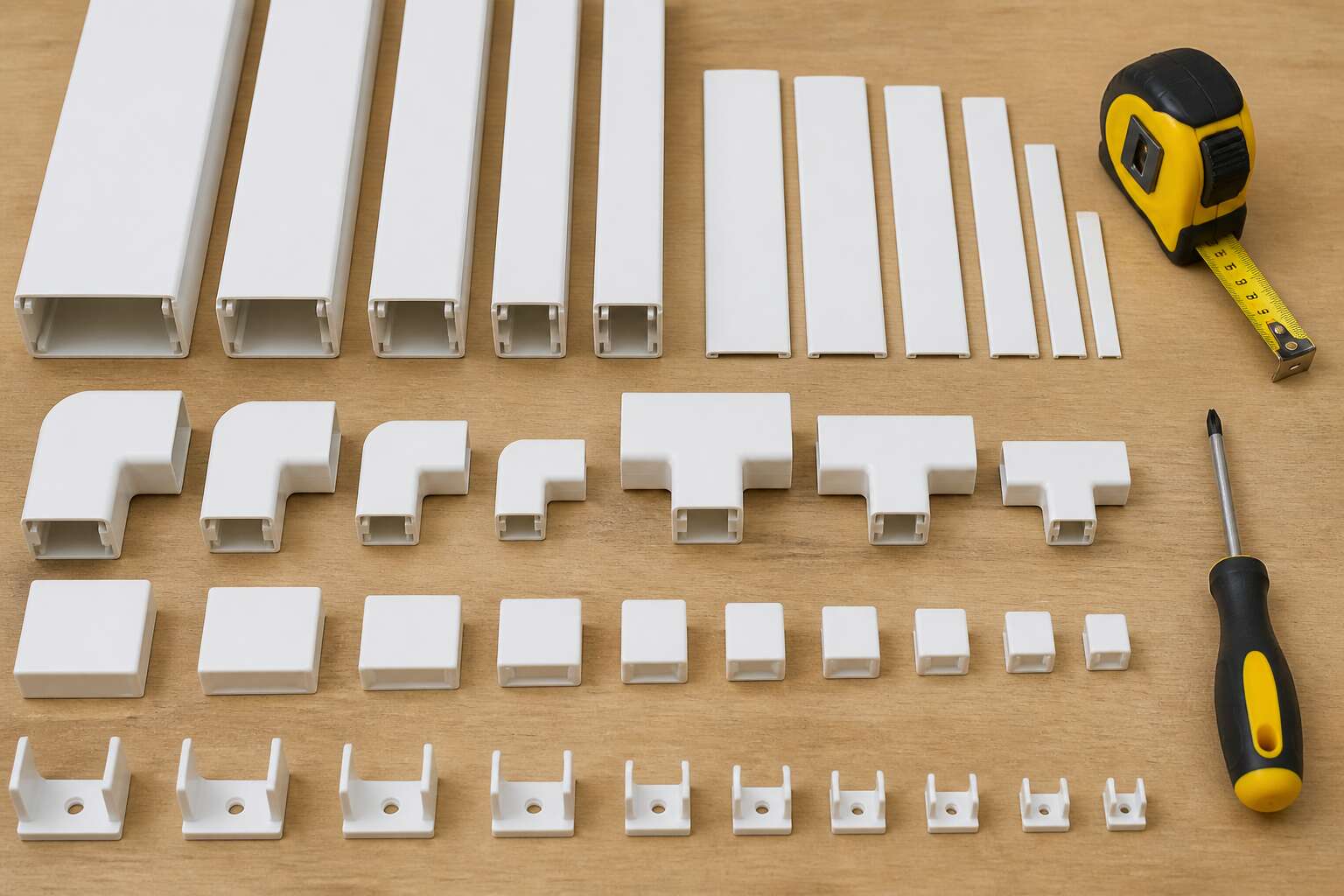
Essential Components for Cable Management
Protective Corner Guides
Cable corners are the most common site of insulation damage in routed installations. That is why protective corner guides deserve more scrutiny than they typically receive.
Protective corner guides sit inside the trunking channel at every change of direction, replacing the abrasive metal edge with a smooth, radiused surface. When a technician pulls a stiff cable through a 90 degree bend, the guide controls the bend radius and prevents jacket damage. This matters in South African installations where temperature swings cause sheathing to expand and contract.
Here is what I look for when evaluating these components:
- Radius controlled profiles that match the cable’s minimum bend specification
- Impact resistant polymer construction that survives repeated access
- Snap in fixings that align with standard trunking base profiles
The right corner guide transforms a vulnerable junction into a seamless transition. When compiling your trunking accessories list, these components should receive the same attention as the trunking channel itself.
End Caps and Finishing Pieces
End caps perform the most overlooked job in cable management. They seal off exposed trunking ends, keeping dust and curious geckos out of your electrical installation. A proper end cap protects cable ends from mechanical damage, turning an abrupt wall termination into something that looks deliberate.
When you compile a trunking accessories list, end caps deserve attention. Consider the available styles:
- Screw fixed caps for high traffic areas
- Snap on caps for quick installation
- Blanking plates for future access
Some caps fasten into the profile. Others use adhesive backing for retrofits. Include these variants when finalising your trunking accessories list.
Finishing pieces also include internal and external corners, which are distinct from the protective corner guides covered earlier. Corners complete the visual line. Guides manage cable bend radius. Each serves a different function.
What about end caps that survive repeated removal? Load shedding means maintenance access happens often. A cap that cracks on first removal defeats the purpose.
Internal and External Bend Connectors
A cable run rarely follows a straight line. Walls turn, corners appear, and your trunking must follow. Internal and external bend connectors make that possible without crushing the cables inside.
Internal bends handle concave angles. External bends manage convex ones. Both preserve the trunking’s internal radius, so conductors avoid sharp edges that cause insulation damage.
- Fixed 90 degree bends for standard corners
- Swept bends for larger cable bundles
- Accessible bends with removable lids for maintenance
Every bend affects the pulling tension on cables. A tight turn increases friction. That is why the right connector matters. A trunking accessories list with the correct bend connectors prevents strain and failed inspections.
Straight Couplers and Joining Plates
Straight couplers join two trunking sections in a straight line. They maintain alignment and protect cables from catching on uneven edges. A solid coupler also preserves the system’s ingress protection. Every trunking accessories list should include couplers sized for the exact trunking profile. I cannot overstate how often mismatched couplers cause trouble later.
Joining plates reinforce these joints. They distribute stress across the seam, preventing sagging or separation over time. Choose internal plates for a smooth exterior, or external plates for easier retrofits. Pay attention to these traits:
- Material thickness for load bearing capacity
- Corrosion resistance, especially in coastal regions
- Tool free or single screw locking
Mounting and Fixing Solutions
Adhesive Backing Options
Securing trunking to a wall should not feel like a battle of wills. Many DIY enthusiasts and even seasoned pros have wrestled with wobbly channels that refuse to stay put. The secret often lies in the adhesive backing you choose, which can transform a frustrating install into a smooth, five-minute job. Adhesive options have evolved far beyond the basic sticky strip, offering robust solutions for uneven surfaces and heavy cable loads.
Before you reach for the drill, consider the environment. A garage subjected to temperature swings requires a different approach than a climate-controlled office. For most interior applications, a high-grade double-sided foam tape provides excellent immediate grip and fills minor gaps in the wall texture. Liquid adhesive, applied in a zigzag pattern along the channel’s base, offers superior hold on porous materials like brick or untreated timber. Here is what you should look for when updating your trunking accessories list:
- Check the temperature rating to prevent adhesive failure in hot roof spaces.
- Ensure the tape thickness matches the roughness of your wall surface.
- Look for solvent-free formulas that won’t degrade the PVC material.
- Confirm the peel strength is rated for the weight of your cables.
Interestingly, the right adhesive can actually simplify the rest of your project. When the base channel is rock solid, fitting the lid and end caps becomes effortless. It reduces the risk of the trunking twisting out of alignment, which is a common cause of unsightly gaps at joints. While your full trunking accessories list might include clips, screws, and brackets, starting with a trusted adhesive often means you can leave the drill in the toolbox for the majority of the run. This method is particularly effective for surface-mounted retrofits where chasing walls is not an option. The result is a clean finish that looks intentional and holds strong against the daily knocks of domestic life, without the headache of patching holes later.
Screw-On Clips and Brackets
When it comes to laying cable, the right mounting hardware quietly separates a flawless installation from a sagging, tangled mess. While adhesive options have their place, there are times when only a mechanical anchor will do. This is where screw-on clips and brackets become the unsung heroes of the tradesman’s toolbox. They offer a permanent, vibration-resistant hold that glue simply cannot match, especially in environments where panels shift, machinery hums, or temperatures fluctuate.
A common mistake is assuming one type of fixing suits every base. Screw-on clips come in a range of materials, from tough nylon to galvanised steel, and each serves a distinct purpose. Nylon is ideal for internal runs where moisture is low, while steel clips are the go-to for outdoor or industrial settings. Selecting the wrong one can lead to corrosion or brittle cracking, so matching the clip to the environment is as crucial as the screw you pair it with.
Here are a few practical pointers for getting the most from screw-on systems:
– Drill the pilot hole accurately. A pilot hole prevents the plastic from splitting, especially in hardwoods or fibre-cement board.
– Countersink slightly. This allows the screw head to sit flush, ensuring the clip snaps shut without added pressure.
– Use the correct screw type. For masonry, use plug anchors; for timber, use a coarse-thread screw. Forcing the wrong thread will strip the fixing.
Beyond simple clips, brackets handle the heavier lifting. When you are routing multiple trunking runs parallel, a stacked bracket set keeps everything tidy and accessible. These are particularly useful in distribution boards or server rooms where bundles of cables converge. They provide a rigid framework that prevents the trunking from bowing under combined weight, preserving the clean lines of the installation.
For those tricky transitions, such as dropping a cable from a ceiling down a bare wall, a specialised angled bracket is the difference between a neat job and a hack. These L-shaped fixings secure the trunking firmly to two planes simultaneously, eliminating the guesswork. They are the critical components that keep cable management looking intentional and professional, rather than an afterthought. Ultimately, taking a methodical approach to your trunking accessories list ensures every screw point is fit for purpose, delivering a robust finish that stands the test of time.
Wall Plugs and Rawl Plugs
Mounting and Fixing Solutions Wall Plugs and Rawl Plugs
“I’ve seen more installations fail at the wall than at the cable,” a seasoned electrician once told me, and he wasn’t joking. The trunking accessories list often feels complete until you hit a hollow partition or a crumbly masonry block. That is precisely where a quality wall plug becomes the silent participant in your cable management system. Neglecting this component turns a straightforward trunking run into a maintenance headache down the line.
Wall plugs and rawl plugs provide the crucial bite that screws need in materials which otherwise refuse to hold a thread. The selection process depends on the substrate you are facing.
– For solid brick or concrete, use a standard nylon wall plug that expands as the screw drives home.
– For plasterboard or hollow walls, opt for a cavity fixing or a spring toggle that opens up behind the surface.
– For aerated concrete blocks, a longer plug with deep fins offers superior grip in the porous structure.
When you add these fixings to your trunking accessories list, you are securing the entire framework against gravitational pull and incidental knocks. A screw with a suitable plug distributes the load evenly, preventing localised stress points that crack brittle materials. This attention to the invisible parts ensures your trunking stays fixed for years, avoiding the frustration of loose sections that rattle with every passing footstep.
Magnetic and Reusable Mounts
Ask an electrician about drilling into a metal cabinet and you will receive a look that needs no translation. Magnetic mounts skip the drill entirely. These fixings turn any ferrous surface into an instant mounting point, placing them firmly in the trunking accessories list. No holes, no dust, no muttered words.
A magnetic base holds trunking firmly for low voltage runs, temporary setups, or any configuration bound to change. Holding force depends on magnet grade and surface condition. Paint, rust, and uneven metal all play a role.
- Neodymium magnets grip heavier cable bundles.
- Rubber coated magnets protect painted surfaces.
- Switchable magnets release with a twist.
You can pull the entire assembly off when the layout shifts, leaving a clean surface. That reusability separates these mounts from glue and screw alternatives. Give the magnet a second glance on your trunking accessories list.
Organizational and Safety Add-Ons
Divider and Separator Clips
A cable trunking system only reveals its true character when you look inside. The unsung heroes of organisation are often the dividers and separators, which prevent a tangle of data and power cables from becoming a frustrating mess. I’ve seen installations where a lack of internal structure turned a simple maintenance task into a full-scale detective hunt.
Dividers allow you to segregate different voltage types within a single trunking run. This separation is not just about aesthetics; it is a fundamental safety practice required by many electrical standards. By creating distinct pathways, you eliminate the risk of interference and make future additions far less disruptive.
For a complete trunking accessories list, these internal components are essential. They are typically crafted from rigid PVC and clip securely onto the base of the trunking channel. Here is how they enhance a professional installation:
– Prevent cross-talk between sensitive data lines and power cables.
– Reduce the time spent tracing individual wires during troubleshooting.
– Allow for a higher density of cables without the risk of overheating.
While contractors often focus on the visible external fittings, the interior layout holds the project together. A robust internal separator strategy ensures that when you open the lid, clarity reigns. Ironically, the parts you never see are often the ones that save the most time in the long run.
Fire-Retardant Barriers
Fire is a silent risk in any cable network. A single short circuit can escalate before anyone notices. Fire retardant barriers act as a physical firewall within the trunking system, stopping flames and toxic smoke from travelling along a cable run. In a country where load shedding often stresses electrical infrastructure, this is not a luxury. It is a means of protecting property and lives.
These barriers are typically rigid sections that lock into the trunking base at regular intervals. They seal the channel completely. This prevents the chimney effect that normally feeds oxygen to a fire. For any serious [trunking accessories list](/blog/trunking-accessories-list), this component demands attention. It is a straightforward addition, but its function is critical.
Consider the installation requirements:
1. Place barriers at every point where the trunking passes through a wall or a floor slab.
2. Use them to subdivide long horizontal runs into smaller fire compartments.
3. Pair them with intumescent putty or pads for a complete seal.
The integration is simple. The benefit is substantial. You are effectively isolating an entire section of cabling from the rest of the structure. This containment gives occupants vital extra minutes to evacuate and prevents catastrophic damage to the building’s core. For an electrician or facilities manager, specifying these barriers is a non-negotiable step in a professional specification. They are the last line of defence against spreading devastation.
Dust and Moisture Seals
Dust and moisture have a slow method. They work their way past loose covers and settle in the spaces between cables. On the Highveld or the coastal fog, that dampness eats the copper itself. A seal prevents this. The foam edges and rubber strips fit under the lid. They also seal the end of the channel.
The list of places where a seal pays for itself is short:
- Where the trunking turns a corner.
- Where two sections butt together.
- Where a cable leaves the trunking into a machine.
The whole seal acts as a barrier. It keeps the dirt from clogging the clips and the water from pooling near the live terminations. For a factory floor, this is a cheap fix compared to cleaning a corroded connection. When you plan your trunking accessories list, you must include a few metres of seal. It is the unglamorous part that ensures everything else works under load.
Specialized and Decorative Accessories
Angled and T-Junction Units
Angled and T-junction units handle the moments where a trunking run changes direction or branches into two separate paths. These fittings let you route cables around corners and split off to a wall socket or a separate work area without losing the neat, continuous line of the system.
A good T-junction keeps the profile clean while allowing a branch to a new direction. Angled units solve those awkward interior corners where standard bend connectors will not fit. Both come in matching profiles and finishes, so the joins remain visually quiet.
On any trunking accessories list, the angled and T-junction units vary in radius and in how they accept divider clips. That compatibility matters on site because it determines whether the internal compartments stay properly separated across the whole run.
Color-Matched Trims and Covers
The moment a trunking run is complete, the raw edges and transition points become the focus. Colour-matched trims and covers are the final layer that transforms a functional installation into a seamless part of your interior. These components conceal unsightly cuts and fasteners, creating a uniform appearance across the entire system. More importantly, they protect the cable pathway from dust ingress and physical knocks at vulnerable junctions, preserving the integrity of the installation over time.
A common oversight is assuming standard white is the only option. The practical benefit of a specific colour match extends beyond aesthetics. In commercial settings, a precise finish helps maintain brand consistency, while in residential projects, it allows the trunking to disappear into the architectural palette. When selecting these finishing pieces, check the material composition. High-grade PVC trims resist yellowing and warping, ensuring the profile remains crisp and durable throughout its service life.
Beyond the basic flat cover, consider the range of specialised profiles available to solve specific challenges:
- External corner covers that wrap neatly around outside edges
- Internal angle inserts for tight inside corners
- Flexible radius covers for curved runs
- Box lids and flanges that integrate with sockets and switches
Each of these additions should lock securely into the base channel without visible screws, maintaining a smooth and safe surface. A well-chosen trim turns a purely functional cable management system into a considered design element, proving that the details of your trunking accessories list determine the final quality of the build.
Metal and Stainless Steel Variants
When standard PVC covers start to feel like a compromise, metal and stainless steel variants step into the spotlight. These are the heavyweights of the trunking accessories list, chosen for environments where plastic simply won’t survive. Industrial kitchens, hospital corridors, and data centres all demand a level of protection that only metal can deliver. The visual shift is immediate too: a machined steel channel conveys permanence and precision in a way that polymer never can. It changes the entire character of an installation, turning a practical necessity into an architectural statement.
But the choice between steel and polymer is rarely about looks alone. The real divergence emerges in how each material handles the daily grind.
– Impact resistance: Steel shrugs off trolley bumps and dropped tools that would crack or dent a PVC base.
– Fire performance: Metallic conduits contain flames and prevent toxic smoke spread, a critical factor in escape routes and public buildings.
– EMC shielding: A continuous steel path can protect sensitive data cables from electromagnetic interference, a non-negotiable in server rooms.
– Temperature tolerance: Unlike plastic, metal doesn’t warp or become brittle in extreme heat or freezing conditions.
These factors often decide the specification before a single screw is turned.
Of course, working with steel demands a different skillset. Cutting requires power tools with abrasive blades, not a simple cable saw. The installer must account for earth continuity, typically linking sections with dedicated brass earth clips. Your trunking accessories list for a metal job will inevitably include these bonding components, plus specific fixings designed for masonry or steel stud walls. The manufacturer must supply clear data sheets covering bending radii, recommended support spacing, and approved joining methods.
So, when you are reviewing your materials for a challenging project, look beyond the standard white PVC range. Consider the location, the traffic, and the fire regulations. A stainless steel run might carry a higher upfront cost, but its lifespan in a tough environment often dwarfs the savings of a cheaper plastic alternative. Make sure your next trunking accessories list reflects the reality of the site, not just the ease of the installation.


0 Comments